

 Tournament News Powered By Lake Drive Marine

Wednesday, May 13, 2026

- Details
BASS Report
 Bassmaster Classic in Knoxville, TN
The venue that was home to one of the most successful and well-received Classics of all-time will once again be the host for professional bass fishing’s biggest celebration in 2023.
B.A.S.S. officials announced yesterday that the 2023 Academy Sports + Outdoors Bassmaster Classic presented by Huk will be held in Knoxville, Tenn., March 24-26 with competition on the Tennessee River lakes of Fort Loudoun and Tellico. Daily weigh-ins will be held at Thompson-Boling Arena — the palatial 20,000-seat venue on the University of Tennessee campus — and the annual Bassmaster Classic Outdoors Expo will take place at the Knoxville Convention Center and the adjacent World’s Fair Exhibition Hall.
The Visit Knoxville Sports Commission will once again serve as host.
“Our first Bassmaster Classic in Knoxville produced record-breaking fan attendance and was one of the best Classics we’ve ever had,” said B.A.S.S. CEO Chase Anderson. “The Bassmaster Classic is the Super Bowl of Professional Bass Fishing. It’s not just a great competition; it is a true celebration of the competitors, the fans and the sport as a whole.
“We couldn’t be more thrilled to be headed back to Knoxville.”
With daily takeoffs from Volunteer Landing, located downtown at the head of the beautiful Tennessee River, the 2019 Classic drew a record crowd of 153,809 spectators and generated an economic impact of $32.2 million for Knoxville and East Tennessee, according to a report released by the Visit Knoxville Sports Commission.
- Details
St. Croix Report
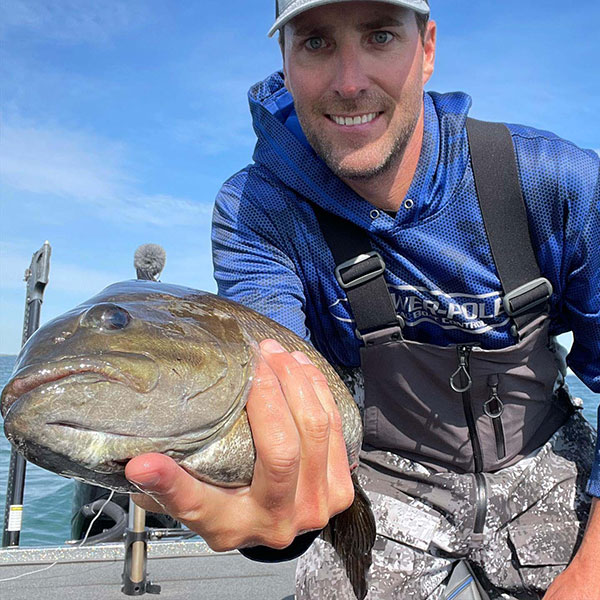 Smallmouth specialist, Travis Manson
Smallmouth specialist and previous Bassmaster Elite angler, Travis Manson, is owner of Travis Manson’s Guide Service and host of the popular Smallmouth Crush live stream and podcast. The wayfaring guide grew up fishing in northern Wisconsin, but now tackles Maryland’s Chesapeake Bay, as well as upstate New York’s St. Lawrence River and Lake Ontario’s 1000 Islands region. He’s particularly handy with a jig, and as angler and guide who spends hundreds of days per year fishing for smallies, Mason considers hair jigs absolutely imperative. “It’s effective at catching smallmouth anywhere fish have good visibility. If I can see two to three feet or more into the water, I feel good about using the hair jig,” says Manson.
The proclivity of hair jigs to entice big fish is now well-known, but that wasn’t always the case. “There is something about the hair jig that smallmouth love, and for a number of years a lot of high-profile anglers were able to keep it to themselves,” Manson says. “Although the hair jig has been around for a long time it really started to come back in the smallmouth community in the mid 2000's. There were a few years when only a few anglers were consistently using this bait and doing very well before word got out. It can be a magical technique at times.”
- Details
Seaguar Report
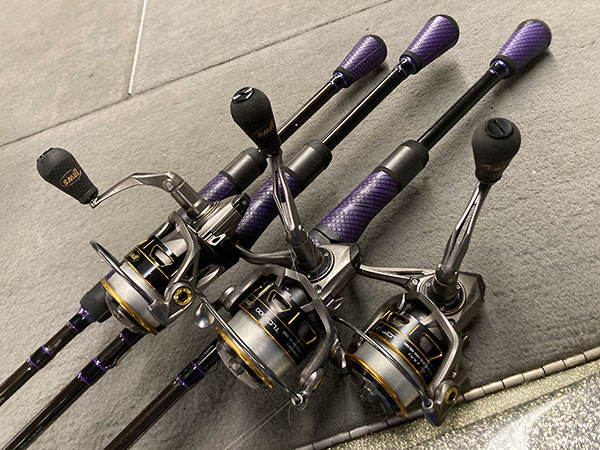 Three spinning reels
Over the past few years, braided lines with a fluorocarbon leader have become a go-to set-up for anglers fishing spinning gear. It's a combination that works exceptionally well and generally; the only question is which connection knot to use. But, some anglers still prefer to use straight fluorocarbon, whether for lure performance or convenience.
This group includes Bassmaster Elite Series pro Mark Menendez and television personality Mark Zona, who make a case for using fluorocarbon on spinning gear.
Why Fluorocarbon?
Those who know Mark Zona, either through meeting him or watching him on Zona's Awesome Fishing Show or his work with Bassmaster, see that he has quite the personality. He takes this into account with his line selection for some techniques.
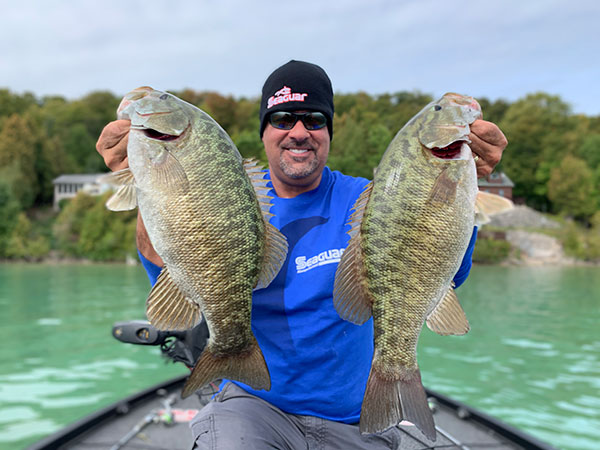 Mark Zona with two nice smallmouths
"I'm a hyper person and fluorocarbon helps me get rid of some of that added action to my lures," he says. "Braided line is great, but the zero stretch causes baits to have a much more exaggerated action with each small movement of your rod. That's good sometimes, but fluorocarbon allows the bait to look more natural and subdued under the surface."