


- Details
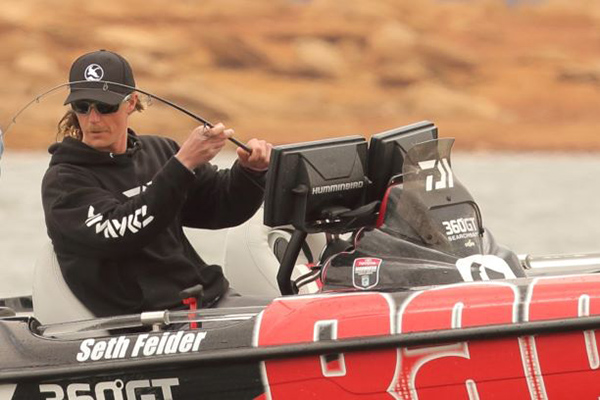 Seth Feider
You won’t find better smallmouth anglers in a sport show lineup than what will be featured at D&R Sports Center’s 31st annual Spring Fishing and Boat Show April 19-20.
In addition to Kevin and Jonathon VanDam, Mark Zona and Chris Noffsinger, speakers will include Minnesota’s Seth Feider and Canadian TV host Dave Mercer at the Kalamazoo shop.
Or, if you want to fine tune your crankbait tactics, renowned cranker David Fritts will be offering his tips.
As always, several boat and tackle vendors will be available to discuss new products and tactics. Special pricing on boats and tackle will be offered during the show.
Attendance is free and hours are 9 a.m. to 8 p.m. April 19 (a Friday) and 9-5 Saturday. For details on seminar schedules, visit www.dandrsports.com.
- Details
MDNR Report
If you're fishing for smelt this year, make sure you know about a legislative change, signed at the end of 2018, that alters how anglers can target smelt in Michigan.
The previous state statute let people use any number of hooks attached to a single line, while fishing for smelt, alewife or other bait fish in the Great Lakes or recognized smelt waters. Now, anglers fishing for those species can use no more than three lines per person, with no more than six hooks or lures on all lines. All hooks attached to artificial bait or “night crawler harness” are counted as one hook (note: for crappie/perch rigs and umbrella rigs, each hook is counted as part of the total six allowed). This means anglers may use up to six hooks on one line or spread the six hooks out over up to three lines.
For more information on fishing regulations, see the current Michigan Fishing Guide, available at fishing license vendors and online at michigan.gov/fishingguide.
- Details
Clear H2o Tackle will conduct its Spring Open House March 22-24 at the Edwardsburg store.
Several new products for 2019 will be on display and special store promotions, giveaways and discounts will be offered.
The shop specializes in panfish, bass, walleye and Great Lakes fishing. A full staff of experienced anglers will be on hand to offer tips and suggestions on how to catch more fish this spring and summer.
Food and drinks will be available to customers throughout the three-day weekend. Store hours are 7-7 Friday, 6-6 Saturday and 6-4 Sunday.
For information call the store at 269-414-4131.
- Details
MDNR Report
Anyone hoping to submit a catch to the DNR’s Master Angler program – which each year recognizes the largest fish of several dozen species – will want to pay close attention to the 2019 application.
A few new rules have been added to the program for 2019, including:
- No more than one entry for fish of the exact same size will be accepted for each species. (For example, if you catch two 10-inch bluegills, submit just one.)
- Each entry must include at least one photo showing the fish being measured. Color photos of the entire fish are required, too; entries received without color photos will not be accepted.
“The DNR’s Master Angler program has more than tripled in popularity in the last five years,” said Lynne Thoma, the program’s administrator. “We want to recognize as many anglers as possible for their fishing accomplishments, while retaining the integrity of this program. We feel these new rules will help us do that.”
The Master Angler program runs on the calendar year (Jan. 1 through Dec. 31), rather than the fishing license year (April 1 through March 31). The program includes more than 50 species of fish in both catch-and-keep and catch-and-release categories. All fish entered must be taken by legal Michigan sportfishing methods, during the open season, and in Michigan waters open to the public.
Download the 2019 Master Angler application at Michigan.gov/MasterAngler. People are encouraged to review the application every year for program changes. Applications can be submitted via mail or email; the current year’s form is due Jan. 10, 2020.
- Details
By Louie Stout
Canoeists, kayakers and fishermen who have used the Michigan DNR’s Dowagiac River’s Sink Road access in Cass County will find it closed and now belongs to the Pokagon Indians.
But don’t fret – another site is being constructed nearby this spring.
The DNR swapped the Sink Road Site with the Pokagon Band for another upstream land parcel on Peavine Road, west of Champlain and near where the Dowagiac crosses under Peavine.
The change was necessary due to construction of a new bridge on Sink Road that required loss of some of the previous state land.
Although the new parcel of land is smaller, DNR District Access Supervisor Gary Jones said it is wider and will provide better access to the river. It also will include designated parking areas.
Jones said construction will begin in May and should take about two weeks.