


- Details
(Provided by Michigan DNR)
The Michigan DNR recently confirmed another new state-record fish, this time a quillback carpsucker. This marks the fourth state-record fish caught in 2015.
The state record for quillback carpsucker was broken by a fish caught by Garrett Reid of Nashville, Mich. on Hardy Dam Pond in Newaygo County June 20. Reid was bowfishing. The fish weighed 8.52 pounds and measured 24 inches.
The previous state-record quillback carpsucker was caught by Benjamin Frey, also on Hardy Dam Pond in August, 2014. That fish weighed 8.25 pounds and measured 22.62 inches†
State records are recognized by weight only. To qualify for a state record, fish must exceed the current listed state-record weight and identification must be verified by a DNR fisheries biologist.
- Details
(Provided by Michigan DNR)
 Michigan Trout TrailsThe Michigan DNR has launched a new tool on its website that showcases quality trout streams and lakes accessible to anglers. Trout Trails is a comprehensive map featuring fisheries biologist-verified trout waters that often are lesser known, but considered outstanding destination points.
Interested anglers should visit www.michigan.gov/trouttrails to access the Web-based Trout Trails application. Please note, Trout Trails is not a downloadable app, but it is compatible with all types of electronic devices.
- Details
(Provided by Michigan DNR)
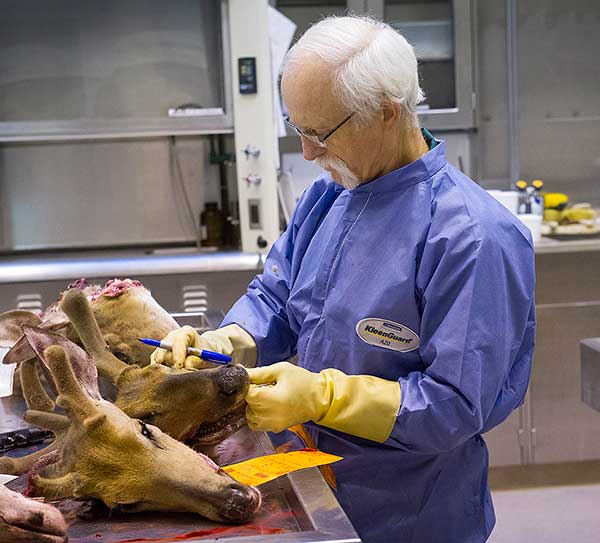 Wildlife Veterinarian Working with Deer CarcassesSince the discovery in May of a free-ranging deer infected with chronic wasting disease in Ingham County, the Michigan DNR has been hard at work sampling deer from the immediate area for additional signs of the disease and putting into effect emergency precautions to prevent as much as possible spread of the disease.
So far, no additional infected animals have been found.
Chronic wasting disease is an unusual neurological disorder that affects members of the deer family. CWD is caused by prions - mutating proteins in the animal’s nervous system - not a bacteria or virus. A form of transmissible spongiform encephalopathy, similar to mad cow disease, CWD causes lesions in the brain. Infected animals exhibit uncharacteristic behavior - they lose their fear of humans, for instance - and gradually waste away. CWD has never been shown to cause illness in humans.
- Details
(Provided by Michigan DNR)
The Michigan DNR recently confirmed two new state-record fish for black buffalo and white perch. This marks the second and third state-record fish caught in 2015.
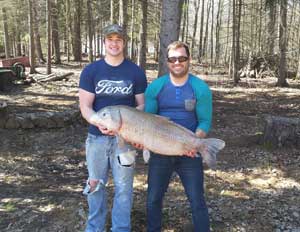 Sage Colegrove and state record black buffalo.The state record for black buffalo was broken by a fish caught by Sage Colegrove of Muskegon on the Grand River in Ottawa County April 12 while bowfishing. The fish weighed 44.54 pounds and measured 38.50 inches.
The record was verified by Rich O'Neal, a DNR fisheries biologist in Muskegon.
The previous state-record black buffalo weighed 41.25 pounds and measured 38.25 inches.
- Details
(Provided by Michigan DNR)
The Michigan Natural Resources Commission decided to eliminate the harvest of antlerless deer during the archery season for hunters using deer or deer combo licenses in the Upper Peninsula.
The restriction, which does not affect the firearm deer season, will be in effect for the 2015-2016 season. The NRC made the decision at its monthly meeting in Monroe, Michigan, in an effort to aid the Upper Peninsula's struggling deer population, which has declined to a level comparable to the early 1980s following three successive winters with severe conditions.
There have been roughly 5,000 to 6,300 antlerless deer harvested in the U.P. by archers over each of the past four years.
Although deer regulations currently are on a three-year cycle, elements such as weather and disease can cause regulations to be reviewed mid-cycle and adjusted when appropriate.