




- Details
p>By Louie Stout
 The Jones family killed these two quality bucks from same spot over 24-hour period.
The Jones family killed these two quality bucks from same spot over 24-hour period.
Deer season may be over, but the stories keep coming, like the one shared with me last week by a LaPorte County hunter.
While several Hoosiers lamented they didn’t see many bucks last fall, that wasn’t the case for Dave Jones.
He and his 78-year-old father, Gene, hunt an 88-acre parcel in southern LaPorte County. It’s kind of an island of habitat surrounded by farm fields. It generally attracts a few deer but not many quality bucks.
Until this year.
Gene, who is retired, hunted there throughout the bow season. Dave, an attorney, works a lot so his hunting time was limited to opening day of gun season.
“Dad saw some deer during bow season but nothing like what we encounter in one weekend,” explained Dave.
- Details
By Louie Stout
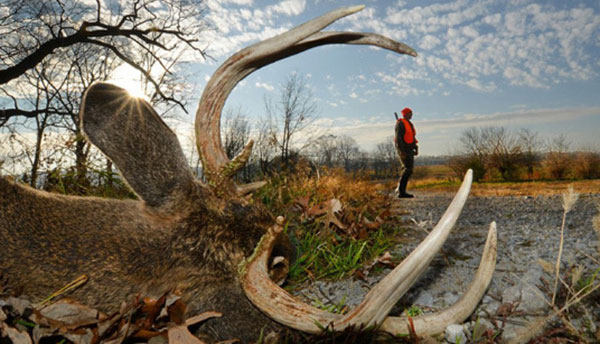 Stats Show Indiana Produces More Trophy Bucks
Does Indiana produce more trophy bucks than Michigan?
Sounds farfetched, I know. Michigan is supposed to be one of the country’s top deer hunting states and little ol’ Indiana, with its vast, fence-row to fence-row plowing seems hardly a deer hunting mecca.
But North Liberty deer scorer John Bogucki says Hoosierland kicks out more trophy bucks than our northern neighbor.
He should know. He is an official scorer for the Hoosier Record Buck Program, Commemorative Bucks of Michigan, Pope and Young, The Longhunter (muzzleloader record book) and Boone and Crockett.
In addition, Bogucki is the record keeper of the Hoosier record book and tracks all the stats of top deer harvested in the state over the years.
And while he doesn’t maintain the records for Michigan’s program, he is an official scorer and studies their record book annually. He knows what’s being killed north of the border.
- Details
By Louie Stout
 Chris Collins poses with the record book buck he shot in Marshall County.
Chris Collins poses with the record book buck he shot in Marshall County.
Chris Collins knew the giant buck he’d seen for a few years still lived somewhere on his farm near Lake Maxinkuckee.
“I found his shed antler last spring and saw him last summer in our bean field,” said the Marshall County real estate broker. “We saw him again on our trail cameras and my brother (Alan) and I were thrilled he was still around.”
The Collins brothers named the buck “Twin Towers” because of its large (29 inches) of brow tines to go along with massive main beams.
They manage their property for quality bucks and this one certainly exceeded the standards. If they were going to kill him, they knew their window of opportunity was closing.
“We’ve been specifically hunting this buck since mid-October,” said Collins. “We passed on several mature bucks because we knew this was the one we wanted.”
- Details
p>By Louie Stout
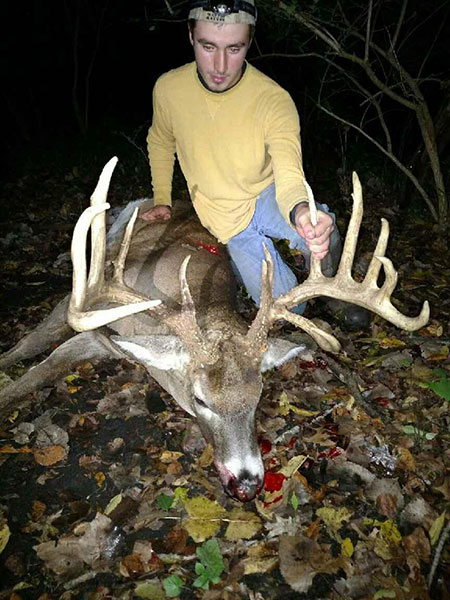 Monster Buck Shot in LaPorte County
Trevor Draves climbed off a roof at the A-Team Construction site where he worked in Rolling Prairie, rushed home to grab his hunting gear then drove to the woods in southern LaPorte County.
It’s what avid bow hunters do in late October when the early rut is underway.
“I didn’t get in the stand until 4 o’clock,” said the 21-year-old LaPorte resident. “But when I saw a good number of does milling around, I figured it was going to be a good night.”
He had no idea just how good it would be.
- Details
By Louie Stout
 Prospects Good for Deer HuntersBow hunters who kicked off the 2016 season earlier this month should see more deer this fall than they’ve seen in recent years.
That’s the report from area biologists who say all indications are that the deer herd has rebounded from the EHD (epizootic hemorrhagic disease) that killed a lot of Michiana animals in recent years.
“I think we’re going into the season with solid numbers,” said Ken Kesson, wildlife manager at Crane Pond Game Area in Jones, Mi. “We’re seeing positive response in areas that were previously impacted by EHD.”
Kesson said he’s had one confirmed report of EHD in Berrien County but other areas have been quiet.