


- Details
IDNR Report
The Indiana Department of Natural Resources (DNR) Fish of the Year program (FOTY), recognizes anglers who have caught the longest fish of each species DNR tracks in that year.
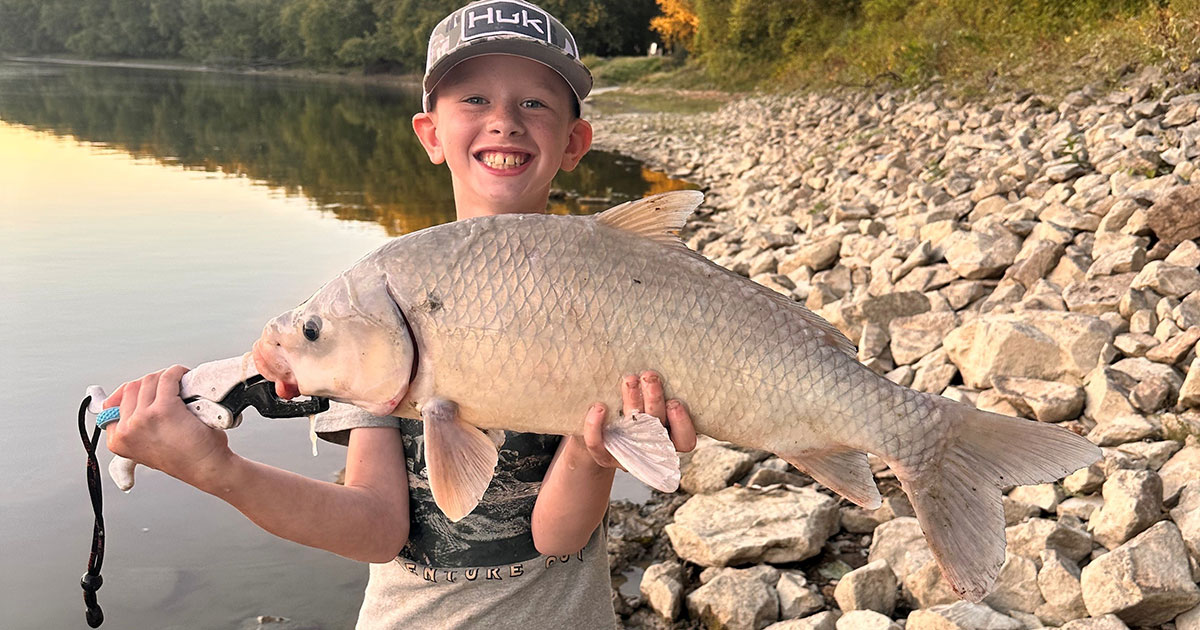
For 2025, Steven Kellett, a Linton (Greene County) dentist, set a new FOTY record with 17 FOTY winning catches, eclipsing the mark of 15 FOTY winning catches set by Liu He of West Lafayette in 2022. The Kellett name also appears five more times on the 2025 FOTY list, as Landon, Steven’s 9-year-old son, caught five winning fish.
To see the complete list of FOTY winners, click here.
The elder Kellett said fishing with his son makes him think back to his childhood and helps him shape his son’s future.
“Spending father/son time away from the everyday stresses of life means everything to me,” Steven Kellett said. “I have awesome memories fishing with my dad and grandfather, and I want Landon to have some of the same experiences that I did.
“A lot of kids these days do not get to experience the outdoors, living in our tech driven culture. When I’m not working or at a sporting event, we make an effort to go fishing! These memories will last a lifetime!”
Steven’s FOTY catches for species that are most commonly pursued by anglers included a 25.5-inch channel catfish he caught at Goose Pond Fish & Wildlife Area, a 22.25-inch saugeye from the Whitewater River in Franklin, and a 21.5-inch brown trout from a private pond in Greene County.
The largest of Landon’s catches were a 28-inch black buffalo from the Wabash River in Sullivan County and an 18.5-inch shorthead redhorse from the Tippecanoe River in White County.
The elder Kellett said the FOTY program serves as extra motivation to fish for both he and his son.
“The FOTY competition offers a unique opportunity to either specialize in a single species or diversify into multiple,” he said. “I enjoy teaching my son to identify different species of fish and learn what is around us.
“We are both goal driven, and we like to log our catches, not only to send in for the competition, but to chart trends, locations, baits, and our own personal bests. This helps us find fish in the future, too.”
To learn more about DNR’s FOTY and Record Fish programs, see on.IN.gov/recordfish. To buy a fishing license and start your next fishing trip, go to GoOutdoorsIN.com or visit one of more than 500 retailers statewide listed at on.IN.gov/HuntFishLicenseRetailers.
- Details
IDNR Report
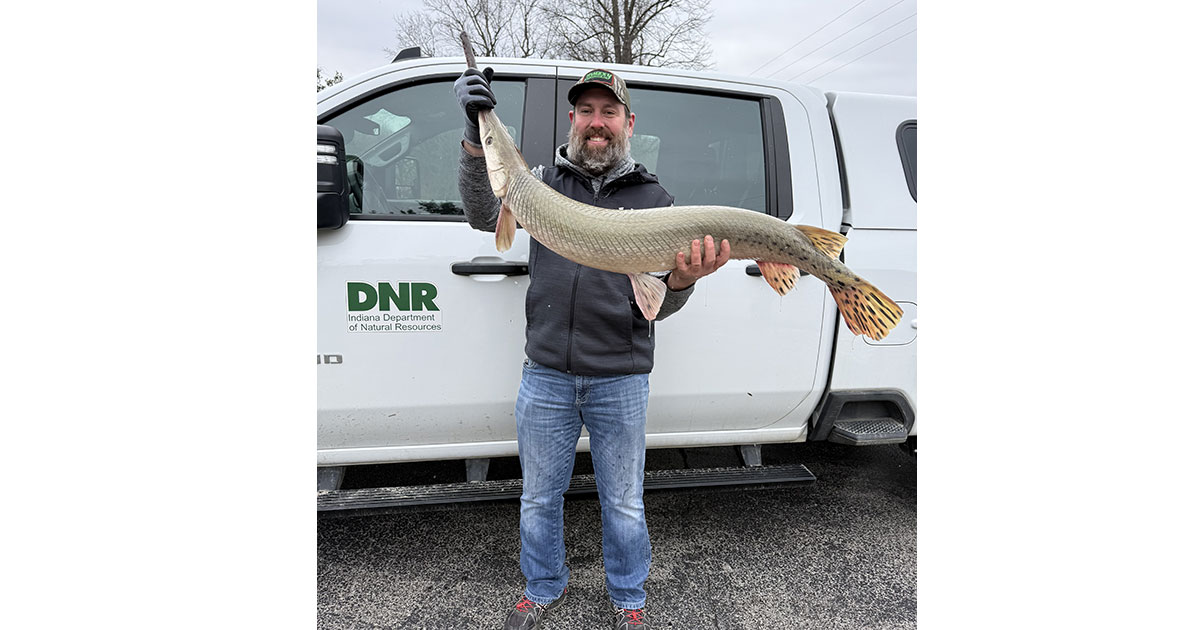
Floyd County resident Justin Brown caught a record-setting longnose gar on the Ohio River on Dec. 30 of last year, on a warm winter afternoon.
The fish weighed 23 pounds, 12.2 ounces, beating the previous record from 2008 by almost a pound and a half. The previous record fish was caught from the White River. Brown caught his gar from a boat using a jigging spoon.
All three of Indiana’s gar records have now been broken in the past three years – the shortnose gar record was set in 2025, and the spotted gar record was set in 2024.
Longnose gar are one of Indiana’s most common gar species. It is found throughout the state, and the largest longnose gar typically live in bigger rivers.
Gar are ambush predators that lie still near the water’s surface, to feed on small fish as they swim past. Gar are difficult to catch using basic hook and line techniques because of their hard, bony mouths. Many methods have been developed to catch gar, including using a snare with bait in the middle that tightens around the gar’s mouth.
Phil Kacmar, who is the big rivers fisheries biologist for the Indiana Department of Natural Resources (DNR), says anglers who use live bait to catch gar should let gar that bite run with the bait to give them time work the bait down in their mouth to have better success landing it.
Visit the Where to Fish map at on.IN.gov/where2fish to find a fishing location near you.
Learn more about the Indiana Record Fish Program at on.IN.gov/recordfish.
Learn about purchasing a fishing license at gooutdoorsIN.com.

- Details
IDNR Report
The Indiana DNR has stocked 70,000 channel catfish in 131 locations and 57,000 fall fingerling walleye in 11 locations since mid-October to expand fishing opportunities across the state.
The channel catfish range in size from 7-12 inches long. The fall fingerling walleye average 5 to 8 inches long, typically reaching 14 inches after two to three years of growth and 16 inches three to four years after stocking.
All stocked channel catfish were stocked in publicly accessible waters after being raised by Cikana (Morgan County), Driftwood (Jackson County), and East Fork (Daviess County) state fish hatcheries.
“Once stocked, channel catfish acclimate to their new environment and start biting quickly while the walleyes will take a few years to reach legal size,” said fisheries biologist Tom Bacula.
Fall fingerling walleye were stocked in Big Turkey, Crooked, and Clear lakes (Steuben), Fish, Pine/Stone lakes (LaPorte), Loon and Sylvan lakes (Noble), Pretty and Wall lakes (Noble), Winona Lake (Kosciusko), and the St. Joseph River (St. Joseph). Those walleyes were purchased from a commercial fish supplier and grown at Fawn River State Fish Hatchery. In addition to these lakes, there are multiple other lakes stocked with walleyes by privately funded lake associations. A stocking permit from DNR is needed to do any stocking.
Anglers are required to follow bag and size restrictions. In most lakes and reservoirs, the statewide regulation is 10 channel catfish per day with no more than one being longer than 28 inches. For walleye, the daily bag limit is six with a minimum size of 16 inches if caught north of State Road 26, and 14 inches if caught south of S.R. 26. A few lakes have a different bag limit, and they are listed in the Fishing Guide, along with all other fishing regulations, at on.IN.gov/fishingguide.
For all fish stocking locations and plans, visit on.IN.gov/fish-stocking.
Learn more about catfishing at wildlife.IN.gov/fishing/catfish-fishing.
Learn more about walleye fishing at on.IN.gov/walleye.

- Details
IDNR Report
The Indiana DNR has closed the bobcat trapping season after reaching the statewide quota.
The season was scheduled to run from Nov. 8 – Jan. 31, or until the quota of 250 bobcats was reached.
The framework of Indiana's bobcat season was carefully designed with a total harvest limit based on population data collected throughout the state. Databases and reporting mechanisms were put into place to allow for close monitoring of the total season harvest.
“Licensed trappers had a successful first bobcat trapping season,” said Geriann Albers, DNR’s furbearer and gamebird program leader. “DNR will review what we’ve learned from this season as we move forward with regulated harvest and bobcat management.”
Additional information on the bobcat trapping season can be found at on.IN.gov/bobcat-season.
- Details
IDNR Report
All veterans and active-duty military personnel, and everyone in their vehicle, will be admitted free to DNR-managed state parks, reservoir properties, state forest recreation areas, and off-road state recreation areas on Veterans Day, Tuesday, Nov. 11.
This includes admission to Falls of the Ohio State Park’s Interpretive Center.
“We honor the sacrifices and service of our veterans and active-duty military and look forward to recognizing them with a day exploring some of Indiana’s most treasured natural places,” said Brandt Baughman, director of Indiana State Parks.
Veterans and military personnel should simply tell the gate attendant at the property that they are either a veteran or serving and on active duty.
For general information about state parks, reservoirs, forest properties, and off-road state recreation areas, see on.IN.gov/recguide.
For information about interpretive programs at state parks and reservoirs, see interpretiveservices.IN.gov.