

- Details
Support from hunters and landowners is essential for early detection and monitoring of chronic wasting disease in white-tailed deer.
This year, there are several options for submitting samples for CWD testing depending on where you are in the state.
- CWD self-submission kits
- Sample submission sites and participating taxidermists
- Testing for a fee
- Additional information
Reminder: Online harvest reporting is required for all hunters who successfully take a deer.
CWD self-submission kits
Pick up a free lymph node shipping kit with instructions and materials for shipping lymph nodes to Michigan State University Veterinary Diagnostic Laboratory, including a prepaid overnight shipping label. There is no charge for the CWD testing. Kits are available for deer harvested in the following counties:
- Clinton
- Dickinson
- Eaton
- Gratiot
- Ingham
- Ionia
- Jackson
- Kent
- Montcalm
More information on how to obtain a test kit is available on the CWD info for hunters webpage.
Sample submission sites and participating taxidermists
Sample submission sites
Drop off the sample and harvest information at an unstaffed drop box or a staffed sample submission site in this year's CWD monitoring areas.
Learn more and find a disease sample submission site.
We need deer heads from the following counties in the Lower Peninsula:
- Bay
- Berrien
- Branch
- Cass
- Genesee
- Huron
- Isabella
- Hillsdale
- Kalamazoo
- Lapeer
- Lenawee
- Livingston
- Macomb
- Midland
- Monroe
- Muskegon
- Oakland
- Oceana
- Ottawa
- Saginaw
- Sanilac
- St. Clair
- St. Joseph
- Tuscola
- Washtenaw
- Wayne
We also need deer heads from the core CWD area in the Upper Peninsula, which includes portions of the following counties:
- Delta
- Dickinson
- Menominee
Participating taxidermists
Successful hunters in the CWD area can bring their deer to participating taxidermists to have the jaw and lymph nodes removed. This accomplishes CWD testing goals while allowing hunters to preserve part of the animal that would otherwise be incinerated after being tested at the Wildlife Disease Laboratory.
Testing for a fee
Deer harvested in all other counties in Michigan can be submitted for CWD testing through one of the following participating U.S. Department of Agriculture-approved laboratories for a fee.
- Instructions to submit samples to the Michigan State University Diagnostic Laboratory.
- Instructions to submit samples to the Wisconsin Veterinary Diagnostic Laboratory.
Results from deer submitted to an approved USDA laboratory using testing for a fee will be sent directly to the hunter from the laboratory.
Additional information
New this year: Online harvest reporting is required for all hunters who successfully take a deer.
Visit Michigan.gov/Deer for harvest reporting information, deer hunting season dates and regulations.
Questions? Contact the DNR Wildlife Division at 517-284-9453.
- Details
MDNR Report
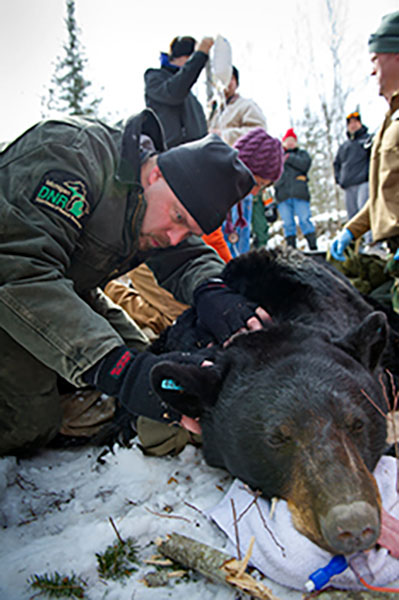 DNR biologist with bear
The Michigan DNR asks hunters and others who spend time outdoors to keep an eye out for bear dens while in the field this fall and – if they find one – to report the location to the DNR to help with an ongoing bear management program.
If you find a bear den in the northern Lower Peninsula, record the location with a GPS unit, if possible, and contact Mark Boersen at 989-275-5151 or BoersenM@Michigan.gov with specific location information.
- Details
GSM Report
GSM Outdoors, a provider of hunting and fishing products, announced its collaboration with Kim Stricker Productions, Inc., underwater videography specialists and fishing content creators, to visually market their fishing brands.
GSM Outdoors fishing brands include Yamamoto Baits, Bill Lewis Lures, Buckeye Lures and SteelShad.
“I can’t overstate the quality and value that Kim’s content brings to our products.” says Crispin Powley, Vice President of Fishing for GSM Outdoors. “No one else can capture and display the action of our products the way Kim can. Ultimately showing the capability and application of our baits to our customers is possible on another level beyond our competitors with what he offers us.”
“Seeing is believing! It’s the service of providing visual validation of the action and effectiveness of fishing lures is what I bring to the table” says Kim Stricker. “I’ve shared an excellent working relationship with Crispin Powley for the past 14 years at Strike King and look forward to delivering the same interactive content to GSM.”
Stricker, an award-winning Michigan underwater videographer, is host and producer of the “Hook n’ Look” televised fishing program and YouTube channel. He is a 2020 Fresh Water Fishing Hall of Fame inductee and 27-year veteran of the Bassmaster and FLW Tournament tours.
- Details
DNR Report
You’ve probably noticed that, over the last few years, deer hunting regulations have become less restrictive in Michigan.
Hunters in the Lower Peninsula can harvest does on a regular deer or deer combo license, and hunters can buy and use up to 10 universal antlerless licenses in most of the state.
Perhaps you’ve been thinking, "The DNR must be crazy! Surely these changes will harm the deer herd."
This video explains the rationale Michigan uses to show it won’t harm the herd.
- Details
MDNR Report
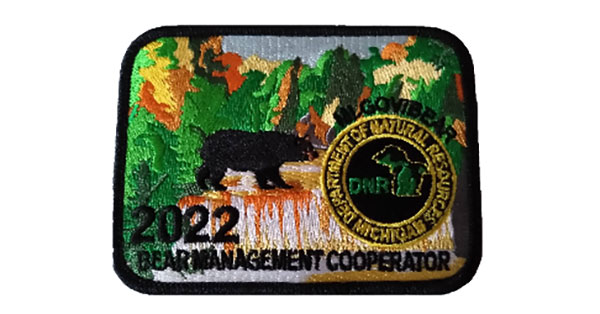 2022 Michigan Bear Patch
The 2022 bear management cooperator patch is a great way to commemorate the recent bear season. Adult hunters, patch collectors and others can buy a patch for $7. Young hunters, 17 years of age and younger, who have a valid bear hunting license can get a free patch.
The Michigan Bear Hunters Association, in partnership with the Michigan DNR, coordinates Michigan’s bear cooperator patch program. Proceeds from patch sales will be used for black bear education and outreach.
You can order patches online or by sending your name, complete address, and a check or money order payable to the Michigan Bear Hunters Association. If the patch is for a youth bear hunter, please send a legible copy of a youth’s valid bear hunting license. Mailed patch orders should be sent to:
MBHA
Bear Patch Program
10510 Fairgrieve Road
Johannesburg, MI 49751
If you have additional questions, please email Cowboys1971@yahoo.com.
Young artists can enter 2023 patch design contest.
The Michigan Bear Hunters Associations holds a design contest annually to create the bear patch. K-12 students attending public, private or home school in Michigan are eligible to enter. To learn more about the patch design contest, visit the Bear Management Cooperator Patch website. The contest entry deadline is Dec. 1.