

- Details
MDNR Report
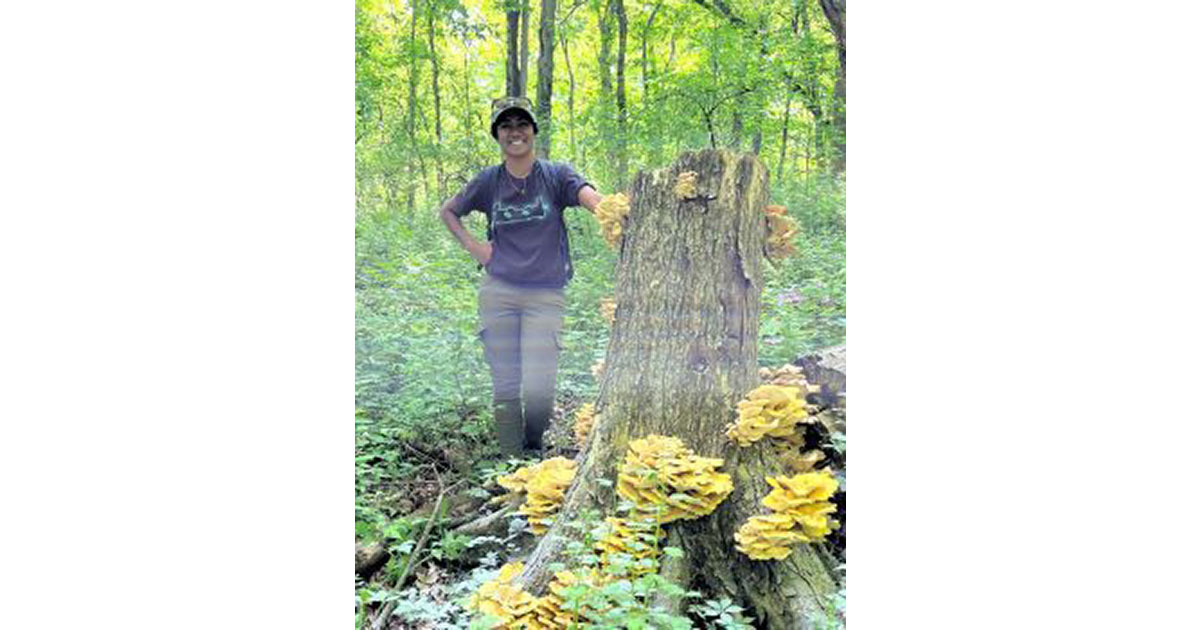
What started as a fun and tasty culinary trend – growing exotic mushrooms at home from a simple storebought or online kit – has become another threat to Michigan’s natural resources.
A recent article published in The Conversation describes U.S. Forest Service researchers’ findings regarding the impact of golden oyster mushrooms (Pleurotus citrinopileatus) on Wisconsin forests.
Native to Asian and Russian hardwood forests, these imported mushrooms are now growing in the wild in areas of the Midwest, including Michigan’s southern Lower Peninsula.
- Details
MIDNR
The Michigan DNR is busy preparing 126 properties for sale via online auctions later this summer. River frontage, lake frontage and forested acreage surrounded by private ownership – these characteristics describe some of the parcels that will be available in August and early September.
It may seem counter-intuitive that the DNR should make any land available for sale, but it’s important to note that the public benefit of some properties is severely limited due to factors such as lack of legal public access, size limitations that prevent appropriate public use, and development on adjacent privately owned land that impacts public use such as hunting. Further, the proceeds from surplus-land sales are deposited into the Land Exchange Facilitation Fund and specifically used to acquire replacement properties that are usable by the public, protect important natural resources and provide accessible, quality recreation opportunities.
For all of those reasons, the DNR determines some properties to be more suitable for private ownership.
These surplus land sales are a regular part of the DNR’s public land strategy (one supported and further defined by the Michigan Legislature with the passage of Public Act 240 in 2018). And since such parcels were determined to be better suited for private ownership, they could prove to be the perfect fit for the right owners.
- Details
MDNR Report
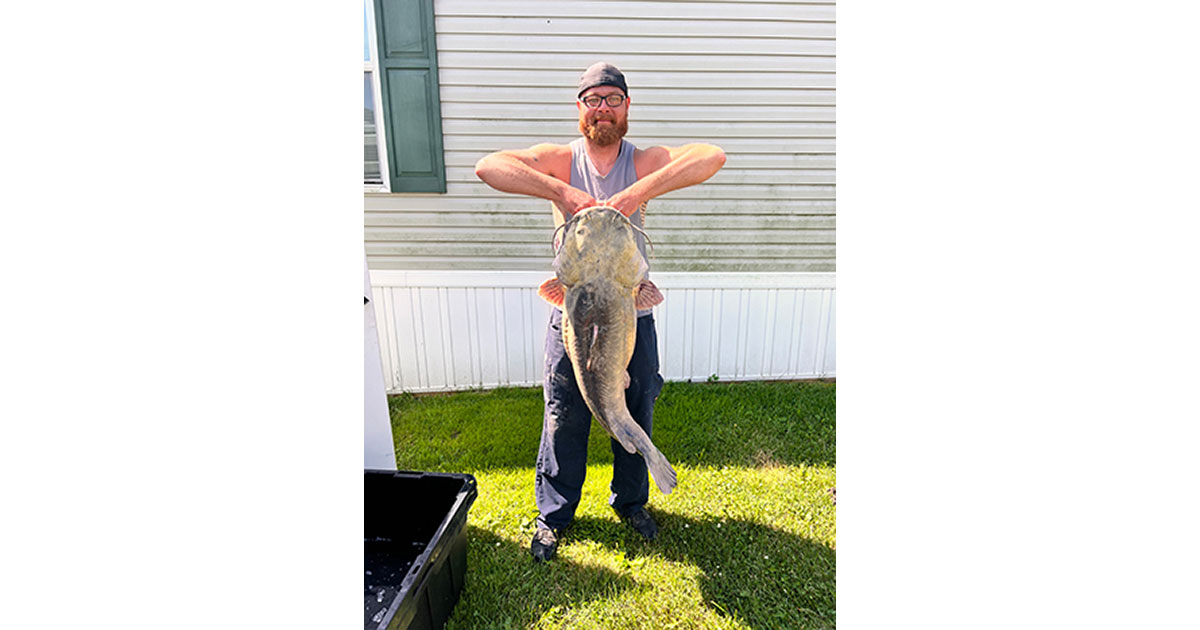
While bowfishing in Monroe County, an angler from Newport, Mich. caught a new state-record fish: a flathead catfish weighing in at 64.46 pounds and measuring 45 inches!
Codie Carlson was bowfishing Plum Creek in the early-morning hours of Sunday, June 29, when he brought in the record-breaker.
This fish beats the previous state-record flathead catfish — 53.35 pounds, 43 inches — caught in 2022 by Lloyd Tanner, of Hobart, Indiana, on the St. Joseph River in Berrien County.
DNR fisheries biologist John Buszkiewicz, who works out of the Michigan DNR Lake Erie Fisheries Management Unit, verified Carlson’s new state-record fish. Buszkiewicz and his crew may have even caught this exact fish during a survey in the same location in 2020; at the time, the fish caught weighed 55 pounds and measured 43 inches.
Carlson, a self-described "true fishoholic," said, "I thought I was about to shoot a channel catfish for dinner. Turns out, I guess we do have flathead catfish in these waters."
About state-record fish
Michigan's state-record fish are recognized by weight only. To qualify, fish must exceed the current listed state-record weight and be weighed on a certified commercial scale, and identification must be verified by a DNR fisheries biologist.
To view a current list of Michigan state-record fish by species, visit Michigan.gov/StateRecordFish.
- Details
MNR Report
Join the Michigan DNR for Hunter Safety Education Week, Aug. 11-17, offering in-person opportunities for more than 2,000 students to obtain a hunter safety education certificate.
More than 40 additional class locations statewide will be posted and available for registration starting Monday, July 7.
To purchase a hunting license in Michigan, anyone born on or after Jan. 1, 1960, is required to successfully complete an approved hunter education course.
Hunter safety education classes are commonly offered in the spring, ahead of spring turkey season, or in the fall, before the firearm deer season. These Hunter Safety Education Week classes – more than 50 in all – are offered in addition to the already planned fall classes.
“Just like preparing for school and fall extracurriculars, hunting season needs to be considered in advance,” said Lt. Tom Wanless, DNR recreational safety, education and enforcement supervisor.
“A lot of people aren’t thinking about hunting season right now because it’s the middle of summer. We don’t want to see everyone wait until the week before they want to hunt to try locating a class, at which point classes are often full,” he said. “We hope that by offering an influx of classes during a set week each year, more people will have enough notice to prepare for hunting season.”
There are four options for completing hunter safety education in Michigan, all of which require at least four hours of in-person instruction:
- Traditional classroom-based course.
- Online course followed by an in-person field day.
- Interactive online course followed by an in-person field day.
- Take-home study course followed by an in-person field day.
Hunter safety education helps the next generation of hunters learn how to safely and responsibly enjoy hunting and understand the importance of wildlife management. The DNR-managed program teaches lifelong skills, such as firearm safety, basic first aid and how to use a map and compass, to an average of 14,000 students per year.
Learn more or register for a class at Michigan.gov/HunterEducation.
Additionally, the DNR is always looking for voluntee
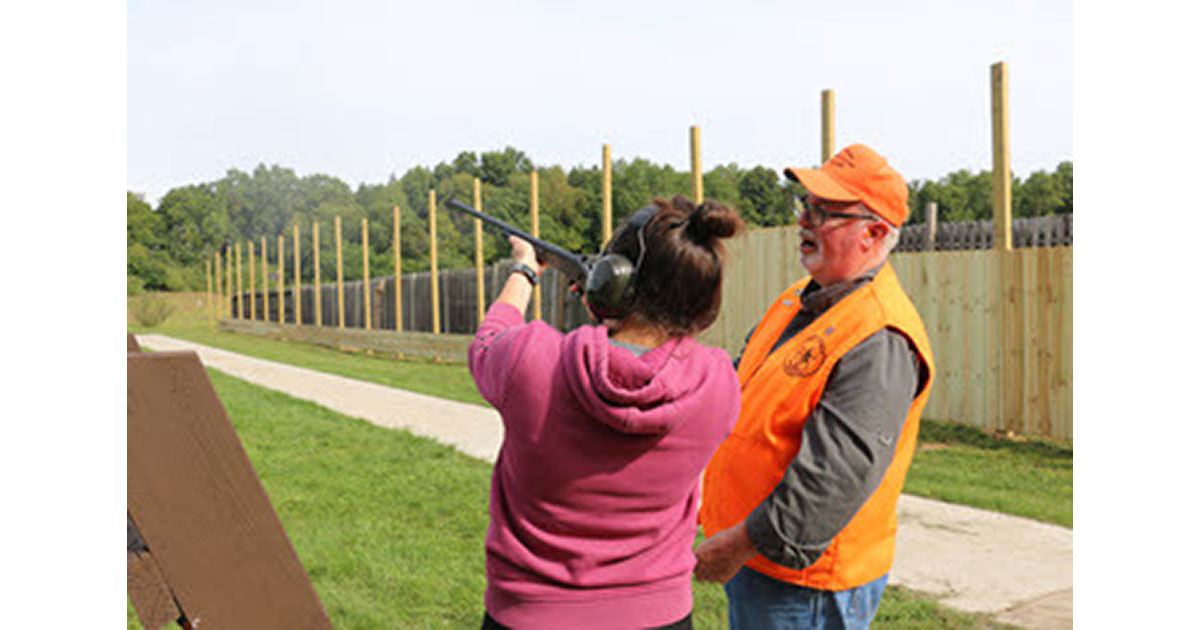
r recreational safety education instructors. If you’re interested in sharing your outdoor experience and safety smarts with those newer to the outdoors, get details on the DNR website.
- Details
MDNR Report
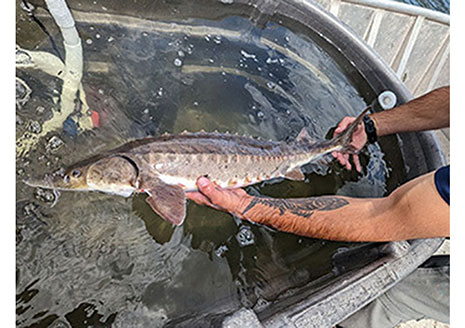
The Little Traverse Bay Bands of Odawa Indians, along with the Michigan DNR, Bay Mills Indian Community and Michigan State University, will be conducting a lake sturgeon survey next month on Burt Lake in Cheboygan County. The goal of the survey is to determine the lake sturgeon population status and the success of stocking efforts. Lake sturgeon is a culturally and ecologically significant species in Michigan, and tribal governments and the State of Michigan cooperatively manage and assess sturgeon populations.
The survey will occur from July 7 to July 25, with nets set Monday through Thursday of each week. Survey gill nets will be used to capture lake sturgeon, and staff will check the nets regularly (every one to two hours) during the day. Nets will be set each day and marked with staff buoys (see image, right), then removed at the end of the day and will not be left in the lake overnight.
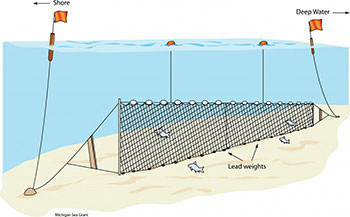 Sturgeon Gill Net
Once captured, lake sturgeon will be measured and tagged with a passive integrated transponder, or PIT, tag (if the fish has not already been tagged). The PIT tags allow staff to uniquely identify individual fish when they are recaptured and provide data needed to calculate a population estimate. Some lake sturgeon smaller than 40 inches will have a small portion of a fin removed for aging. This will allow staff to evaluate growth of both stocked and naturally produced lake sturgeon in Burt Lake. Surveys following the same protocol were recently conducted on Black Lake (2023) and Mullett Lake (2024) to evaluate stocking efforts.
Please be on the lookout for survey buoys and avoid them while boating on Burt Lake this July. If you have questions about the survey, please contact Dylan Jones (djones@ltbbodawa-nsn.gov), Neal Godby (GodbyN@Michigan.gov), Emily Martin (MartinE13@michigan.gov), or Frank Zomer (fzomer@baymills.org).
For more information about lake sturgeon assessments, visit Michigan.gov/DNR/Managing-Resources/Fisheries/Tribal/Inland/Sturgeon. You can also learn more about lake sturgeon at Michigan.gov/Sturgeon.