

- Details
The Michigan DNR reminds hunters that applications for Michigan elk and bear hunting licenses are available now through June 1. There will be 100 elk licenses and 7,831 bear hunting licenses available for the 2014 hunting seasons.
Only Michigan residents are eligible to apply for an elk license. Bear licenses are available for both residents and nonresidents; however, no more than 2 percent of licenses in any bear management unit will be issued to nonresidents. Hunters can apply online at www.michigan.gov/huntdrawings at any authorized license agent or at a DNR Customer Service Center. A nonrefundable $5 fee is charged at the time of application. Hunters may purchase just one bear and one elk application.
Applicants may call 517-284-WILD (9453) for assistance with their application and may check their drawing results online at www.michigan.gov/huntdrawings. Also see the 2014 Michigan Elk Hunting Digest and 2014 Michigan Bear Hunting Digest for more details about the application processes.
- Details
(Provided by Michigan DNR)
The Michigan Department of Natural Resources annually adjusts fishing regulations to ensure that the state’s fisheries' resources are managed properly and to provide the best benefits to anglers and the public.
For the coming 2014-2015 angling year, which starts Tuesday, April 1, the DNR would like anglers to be aware of the following new fishing regulations:
- Details
(Provided by Michigan DNR)
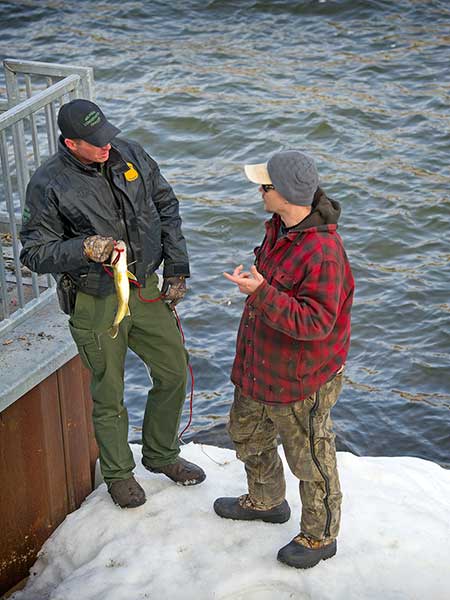 Michigan DNR conservation officer Brian Lebel checks a fisherman below Croton Dam on the last day of walleye season.After a short foot patrol in Mecosta County’s Haymarsh State Game Area, conservation officers Brian Lebel and Mike Wells – who had been looking for trap sets near active beaver dams – returned to their snowmobiles. Upon revving up for the day’s next mission – crossing the lake to check for hunters and snowmobilers elsewhere in the area – Lebel’s snowmobile wouldn’t move. The tracks had seized and, despite their best efforts, neither officer could make the tracks budge.
Wells jumped on his machine and headed back for the truck in order to haul the disabled snowmobile out of the woods.
- Details
The Michigan Department of Natural (DNR) Resources’ Southern Lake Michigan Management Unit in Fisheries Division has announced a public forum in Kalamazoo to discuss local and statewide fisheries management activities and concerns.
The forum is set for Thursday, March 27, from 6:30 to 7:30 p.m. at the D&R Sports Center, located at 8178 W. Main St.
- Details
(Provided by Michigan DNR)
Thanks to the generosity of many hunters and anglers, Michigan food banks and kitchens will have more fresh venison for meals provided to their visitors.
During the 2013-14 year, Sportsmen Against Hunger (www.sportsmenagainsthunger.org) received more than $50,000 – a record amount – in donations from Michigan outdoorsmen and women.