

 Tournament News Powered By Lake Drive Marine

Friday, June 12, 2026
Friday, June 12, 2026
Thursday, June 11, 2026


- Details
By Louie Stout
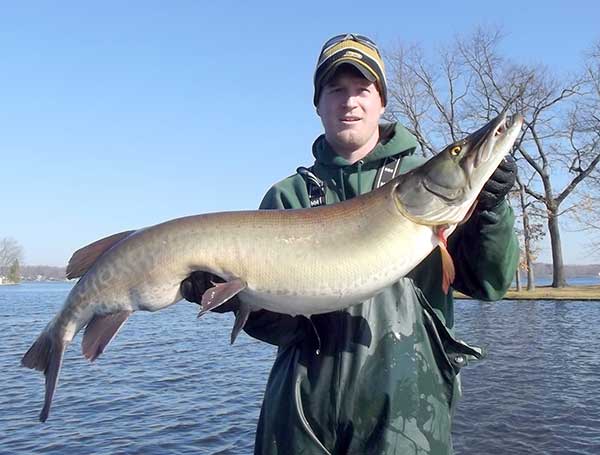 Indiana Muskie Fishing is Even Better Than Most Anglers Realize
Are Indiana’s muskie lakes starting to get the respect it deserves?
Maybe. But not as much as muskie biologist Jed Pearson believes they should.
Webster Lake has long been known as the crown jewel of Indiana muskie fishing and it’s been recognized regionally, and to some extent, nationally. It and nearby Barbee Chain and Lake Tippecanoe gets most of the attention. All of those lakes are in Kosciusko County.
“We think it’s important to get more information out there about the quality of fishing we have here,” said Pearson. “We’re seeing it in our surveys, but now it’s a matter of getting anglers to try other waters and see what they are missing.”
The Webster/Barbee/Tippecanoe trio of muskie lakes are fairly well known and garnering more attention.
The Indiana Classic has been held there for several years, attracting avid muskie anglers from around the region.
- Details
MDNR Report
The Michigan DNR, in partnership with the Michigan Muskie Alliance, continues to investigate the state's muskellunge fisheries through its online angler survey.
The 2017 Muskellunge Angler Survey is gathering information about muskellunge angler demographics and catch data. Muskellunge anglers have been surveyed since 2014, but only online since 2016. Traditional methods, including creel and postcards, have not been as successful at collecting this type of information. The current survey can be found on the DNR's website at www.michigan.gov/muskie.
- Details
By David A. Rose
Traditions Media
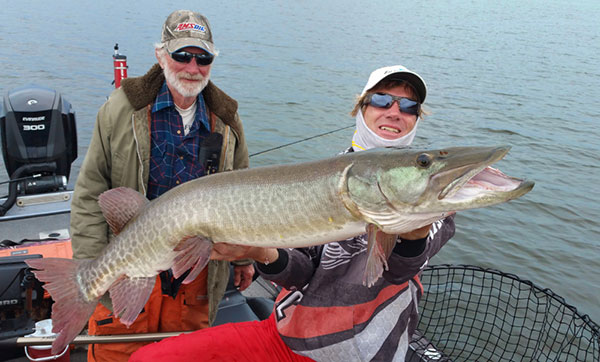 Be quick if you decide to take a photo like this and get the fish back into the water immediately. (Courtesy of Pete Maina)
Be quick if you decide to take a photo like this and get the fish back into the water immediately. (Courtesy of Pete Maina)
It’s an unfortunate fact, but I’ve come upon many a muskie, belly-up on the surface within some of the inland lakes near my home in Michigan’s Northwestern Lower Peninsula. If the fish is freshly departed, I’ll grab my boat hook and roll the fish around to see if I can conclude what may have been the cause of its demise.
More often than not, two unconcealed hints usually give away its death: Torn lips and gums, indicating the fish had been caught, and fins and tail tinted bright-red, signifying a high level of stress.
Although the muskies caught in my neck of the woods grow enormous—the state record, for example, a whopping 58-pound Great Lake strain landed in October of 2012—their populous is low. The Michigan Department of Natural Recourses’ surveys show a population of one fish per square mile in one of the most popular chain of lakes for targeting them. To say just a single dead beast is distressing for such a small population is an understatement.
But there’s also no doubting that landing such a large fish is one of the most exhilarating moments in any angler’s lifetime, whether it was muskie being targeted or if the fish was an accidental catch. But there’s no more important time for anglers to calm down than once the fish is netted, making sure it’s safe from harm well before high-fives are given overhead.
- Details
Dr. Jason Halfen
www.technologicalangler.com
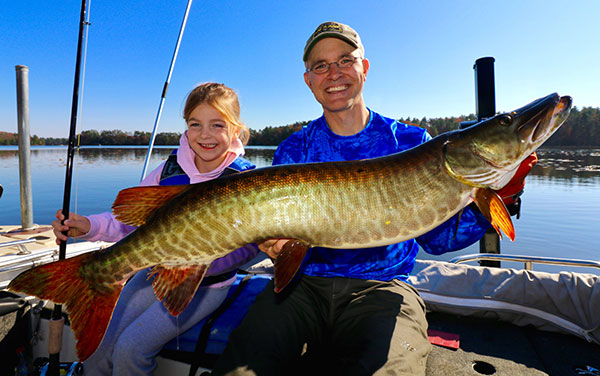 Hi-Tech Solutions to the Summer Musky Puzzle
Musky activity peaks in late summer, as warm water temperatures drive these apex predators to feed opportunistically on abundant natural forage, and to aggressively chase anglers’ baits. Full-time musky devotees frequently drop their paychecks on custom topwaters and giant multi-blade bucktails, study the moon and sun charts, and target trophy waters to get their summer musky fix. Then, there are the rest of us: anglers with families and jobs, who split limited fishing time among several different target species swimming in convenient locations. For us, the musky bug has yet to take complete hold. Nevertheless, we still enjoy the chase, and revel in its success as we lift muskies from the big Frabill net, snap a quick photo and send Esox back to the depths. How can we enjoy consistent summer musky success, without devoting our entire existence to catching them? For me, modern technology levels the playing field, and puts summer muskies in the boat when I’m not chasing river smallmouth, cleaning the cabin gutters or pulling the kids on the tube. Here are four “tech tips” to help you hoist more warm weather muskies this season.
- Details
By Ted Pilgrim
Traditions Media
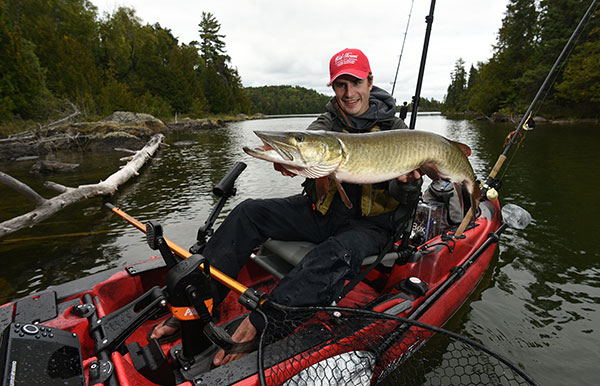 Patience, Petite Tackle and Opening Day Muskies
Eight months is a long time to wait between casts. When the season finally opens in May or June in Minnesota, Wisconsin and Ontario, casting withdrawal reaches maximum angst. It’s just the sort of abstinence that can elicit a nasty case of lure charades, that nervous habit that makes certain anglers constantly change baits.
A dude I used to fish with had it bad, manically switching lures in hopes of discovering the one. You know the type. When follows are sparse, lure-changer rotates through whole piles of baits, a new one clipped to the leader every ten casts or so. And most of these anglers carry a boatload.
Now, as a bit of a lure collector myself, I’ve been guilty of the occasional wild experiment, believe me. But most openers, good, bad or otherwise, I mostly limit myself to a couple favorite baits, throwing them uninterrupted for 12-hours. Not that I don’t occasionally get tempted by what ifs.
For my friend, it wasn’t so easy. One winter, he’d accumulated a load of new baits—more ballast for his already over-crowded lure rotation. Things got dicey that particular opening day, as I recall counting 11 different lures clipped to his leader in the space of a single hour’s fishing. Late that afternoon, it looked like a jack-in-the box of baits had exploded all over his casting deck.