Tournament News Powered By Lake Drive Marine

Friday, June 12, 2026
Friday, June 12, 2026
Thursday, June 11, 2026


- Details
MON Report
Michigan and Indiana announced their free fishing days for this year – when no licenses required but all other regulations are in play.
Michigan’s first freebie is this weekend, Feb.19-20. Unlike Indiana, non-residents are included among those who won’t need a license. The second free weekend is June 10-11. Learn more at Michigan.gov/FreeFishing.
Indiana’s free fishing days are May 1, June 4–5, and Sept. 24. Indiana residents do not need a fishing license or a trout/salmon stamp to fish in public waters on these days. Non-residents are required to have a license.
- Details
Seaguar Report
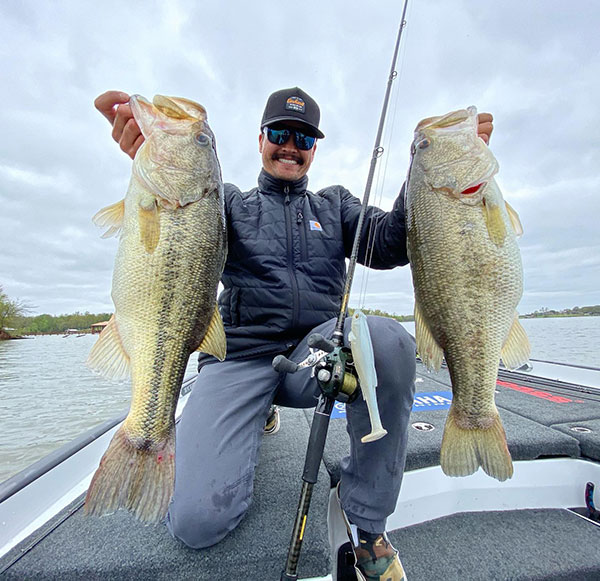 Chris Zaldain
The swimbait is a lure type that has gone from trophy hunting bass anglers to something used for many different species, including walleye. They come in all shapes and sizes and can be fished all year long, making them some of the most versatile lures used today.
In addition to the many types and actions available for swimbaits, they come in many colors and can be rigged and fished in countless different ways.
But, one of the first things to consider is what swimbait to use and that varies considerably based on forage size and where you are fishing. Seaguar pros Bassmaster Elite Series angler Chris Zaldain and National Walleye Tour pro Brian Bashore weigh in on how they select the right swimbait for a given situation.
Trophy Hunting, Tournaments, and Smallmouth
Texas pro Chris Zaldain grew up in California and witnessed the evolution of swimbaits first hand and fell in love with throwing big baits. He's carried that into a career as a professional angler and still counts swimbait fishing as one of his strengths and favorite ways to target bass.
- Details
By Josh Lantz, Traditions Media
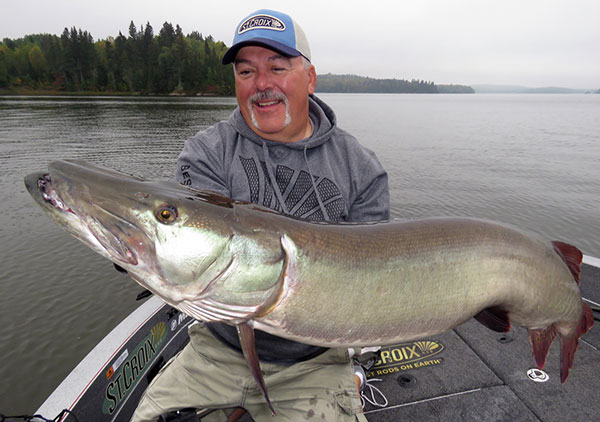 Steve Heiting with nice fall musky
Musky anglers don’t always agree on the best ways to catch the fish of 10,000 casts. Variations in today’s lures and tackle mean there’s more choices than ever to support multiple musky techniques and presentations, any of which can decrease that 10,000 number to something a lot more reasonable. That said, at least three of the most successful musky anglers in the Upper Midwest do agree on something: the month of September is one of the best times to be on the water.
“The pre-turnover period that occurs from the last week or so of August and continues pretty much throughout September has become my favorite time of the whole musky season,” says Minocqua, Wisconsin-based musky hunter, outdoor communicator, and fishing promoter, Steve Heiting. “During this time, we will see and catch many of the biggest muskies of the entire year. It generally starts when water temperatures cool to below 70 degrees, but really ramps up between 65 to about 58 degrees. After that, turnover is on the verge of happening and this particular bite is mostly over. I’ve succeeded fishing this pattern throughout Wisconsin, Minnesota and Ontario, and understand it also works just fine in southern reservoirs — just a little later in the year.”
Heiting says the pattern is a musky caster’s dream because the fish — including those giants that lived in the deep lake basin all summer — move shallow, and they’re there to feed. “Muskies can be very individualistic, so they may not all move at once, but the ones that are shallow will be biting. They will use shallow sand flats, weeds that are still green, or rocks,” says Heiting, who adds that the thickest, greenest coontail and cabbage beds are among the best places to start the hunt. “Wind helps, especially on rock spots, but it isn’t necessary to trigger fish,” Heiting continues, adding that the biggest muskies will almost always use spots that have deep water nearby. “In dark water systems, I generally position my boat in six feet of water and fish shallower, and in clear water systems I may hold the boat in about 10 feet and fish shallower, but it depends on the layout of the spot.”
- Details
Seaguar Report
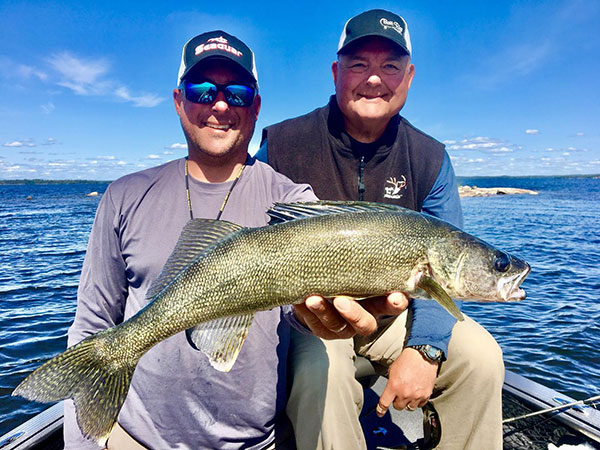 Fishermen with nice walleye
As fishing techniques have progressed, specifically for bass and walleye anglers, the equipment has become more and more specialized in recent years. There are many great reasons to use rods, reel, and line that are fine-tuned for a specific application.
But there is also a case for keeping things simple.
One of the best ways to keep things basic and match the situation at hand is to use a braided line for spinning gear and adjust leaders based on the conditions and techniques. That's the approach that professional bass angler Miles "Sonar" Burghoff takes to ensure that he is ready for anything he is faced with on the water. Wisconsin fishing guide Jeff Evans takes an even more simplified lane, settling on the same mainline and leader combination for a host of different techniques for walleye fishing.