


- Details
By ANDY EVANS, MDNR
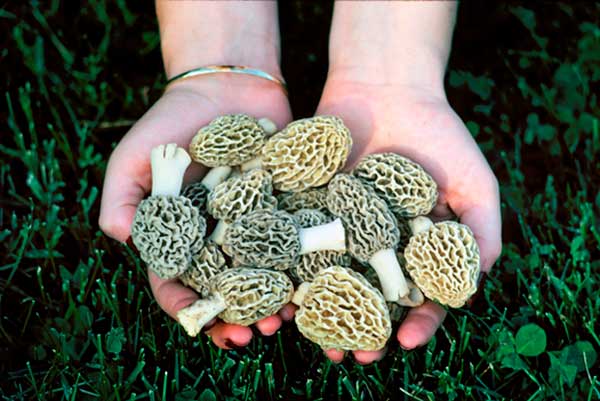 Hunting Michigan Morels with Mi-HUNT
It was early May, and a certain spring activity was on my mind - looking for some tasty morel mushrooms in the beautiful hardwood forests of northern Lower Michigan.
As that Fridays work shift was drawing to a close, I thought about places on state-managed land that I might find a new honey hole - a spot covered with morels.
A new weekend adventure would soon be at hand, and an amazing forest with rolling hills awaited. We are quite fortunate here in Michigan, having over 4.6 million acres of state land to explore.
- Details
By Bob Gwizdz, MDNR
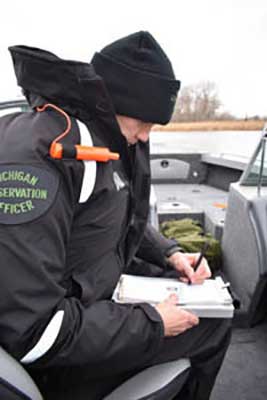 A Day in the life of Michigan Conservation OfficersA Michigan conservation officer takes down information alongside an off-road vehicle.
For conservation officers Jason King and Will Brickel, who patrol Saginaw County, the second Saturday of March offered an atypical work assignment.
They were paired to patrol a section of the Saginaw River on the last Saturday before walleye season closed for six weeks.
The officers were part of a four-boat crew that the Michigan Department of Natural Resources had deployed during a saturated patrol, a technique the DNR uses when it expects a lot of traffic in a specific area.
King, 32 and a conservation officer for three years, and Brickel, 29 and serving in the role for four years, said they work alone 90 percent of the time. But both said they prefer to partner up when they're working in a watercraft.
"Typically for marine patrol, we try to work in pairs because it's easier and safer," Brickel said.
- Details
MDNR Report
A central Michigan game ranch owner has been sentenced on charges of falsifying information related to chronic wasting disease testing.
Lester Jay Gemmen, 64, of Morley was charged with providing false information regarding the origin of two deer heads that were submitted for disease testing, and for failing to properly maintain fencing at the Super G Ranch. The ranch is a privately owned cervid (POC) facility, a designation that includes game ranches and hunting ranches.
- Details
Got a question, suggestion or beef about southwest Michigan fishing?
Michigan fisheries biologists will be available April 9 at Southwest Michigan College Conference Center near Dowagiac to hear your comments or answer questions.
DNR biologists will be available to discuss whatever topic you choose and you can show up anytime between 6:30 and 8 p.m. to talk to them.
The conference center is located at 58900 Cherry Grove Road in Dowagiac.
- Details
Kevin VanDam, Mark Zona, Terry Scroggins and Al Lindner will headline an all-star seminar cast during the D&R Sports Center Spring Fishing Show this weekend.
Other seminar speakers during the two days include Kalamazoo’s Jonathon VanDam, FLW pro Mark Rose and smallmouth guide Chris Noffsinger.
Show goers also can register for a drawing to win a free fishing trip with Zona.