


- Details
MDNR Report
To simplify the public's ability to report fish kills, the Michigan DNR recently developed an online form for reporting fish kills in quantities larger than 25 fish.
A fish kill of this size could have more factors involved that need further DNR investigation. The new Sick or Dead Aquatic Species form can be found in the DNRs Eyes in the Field application at www.michigan.gov/eyesinthefield.
Information requested in the form includes waterbody and location (both descriptive and latitude-longitude coordinates), observation details, and any available photos showing the fish kill. Close-up photos showing any external disease signs such as bloody patches, unusual wounds or odd coloration are particularly helpful to DNR staff as they try to determine the cause of the issue and its seriousness. Entered reports and associated images automatically are forwarded to fish health staff for quicker evaluation and action.
- Details
MDNR Report
Michigan State University and the Michigan DNR will be placing location-tracking collars on white-tailed deer in south-central Michigan as part of a multiyear study of deer disease, including chronic wasting disease.
The study will assess deer movement and distribution patterns and their influence on disease spread in and around Clinton and Ingham counties. This is one of a series of aggressive actions to address CWD in Michigan's deer population and to maintain healthy wildlife for current and future generations.
Chronic wasting disease attacks the brain of infected animals, creating small lesions, which result in death. The disease is transmitted through direct animal-to-animal contact or by contact with saliva, urine, feces, blood or body parts of an infected animal, or infected soil. CWD first was detected in free-ranging deer in mid-Michigan in 2015.
- Details
MDNR report
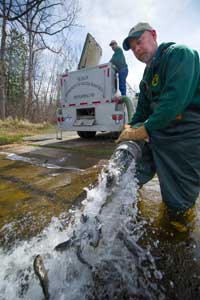 Michigan Stocked 11.4 Tons of Fish Last FallThe Michigan DNR announced the totals from its 2017 fall fish-stocking efforts. The DNR stocked nine different species totaling 834,175 fish that weighed nearly 11.5 tons. Fish were stocked at 76 locations throughout the state.
"It was another outstanding fall fish-stocking season that will provide enhanced opportunities throughout Michigan," said Ed Eisch, DNR fish production manager. "When added to our successful spring and summer stocking efforts, that brings the total for 2017 to more than 26.4 million fish put into Michigan's waters."
The number and type of fish stocked varies by each hatcheries ability to rear fish differs because of water supplies and temperature. In Michigan, there are six state and three cooperative hatcheries that work together to produce the species, strain and size of fish needed by fisheries managers. These fish must then be delivered at a specific time and location for stocking to ensure their success. Most fish in Michigan are stocked in the spring.
- Details
MDNR Report
For just $11 (or $6 for motorcycles) a year, Michigan's Recreation Passport enables Michigan-registered vehicles access to more than 100 state parks, hundreds of miles of trails, historic sites, boat launches and other state-managed destinations. That's just 3 cents a day for a years' worth of outdoor exploration.
Starting Jan. 1, 2018, the Michigan DNR will add a $5 convenience fee for resident Recreation Passport purchases made at state parks. This is the same fee Secretary of State charges when a resident adds a Recreation Passport to a vehicle outside the annual registration renewal cycle.
To avoid paying the convenience fee, customers can buy the Recreation Passport online at expressSOS.com, by mail, at a self-service station or in person at a branch office at the time of registration renewal. If a customer wants to add a Recreation Passport to a vehicle after it's registered, they can return to Secretary of State or visit a state park and have it issued for $16 ($11 Recreation Passport plus $5 convenience fee for vehicles) or $11 for motorcycles ($6 Recreation Passport plus $5 processing fee).
- Details
MDNR Report
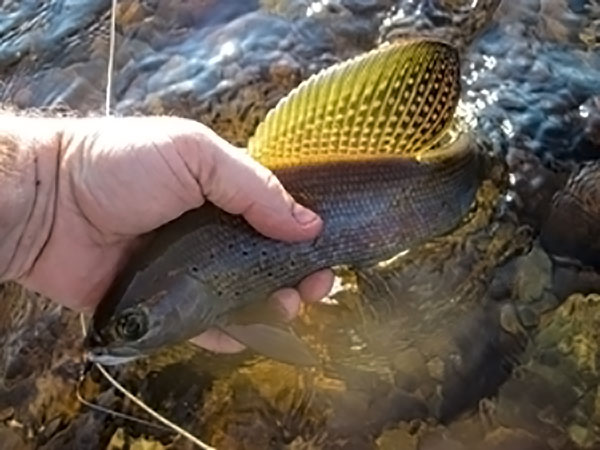 DNR Gets $180,000 Donation for Arctic Grayling Project
Philanthropy continues to have a prominent role in the historic reintroduction of the Arctic grayling to Michigan, with the award of an $180,000 gift from the Henry E. and Consuelo S. Wenger Foundation to the Michigan DNR.
The funds will support a research project as part of Michigan’s Arctic Grayling Initiative.
DNR Fisheries Chief Jim Dexter shared news of the gift at today's Michigan Natural Resources Commission meeting in Lansing.
This initiative is a statewide partnership effort focused on restoring self-sustaining populations of this native fish and was founded by the DNR and the Little River Band of Ottawa Indians in June 2016. The partnership includes more than 40 organizations.