


- Details
(Provided by MDNR)
The Michigan Department of Natural Resources today announced that test results on fish collected in the ongoing fish kill event on Lake St. Clair +AFs- http://www.michigan.gov/dnr/0,4570,7-153-10366/54559/10402-409793--,00.html +AF0-were confirmed to be positive for viral hemorrhagic septicemia virus (VHSv). Fish were collected during late March and early April and included gizzard shad, bluegill, and black and white crappie.
"A total of 165 fish have been tested thus far using pooled samples of five fish, and of the 33 pooled samples, 31 of them have been positive for VHSv," said Gary Whelan, research program manager for the DNRs Fisheries Division. "Ten gizzard shad were tested individually and all were positive for the virus. These results confirm what we initially suspected, given the external signs on the fish, species involved, and timing of the fish kill, all strongly implicating VHSv as the cause of this fish kill."
Based on both public and other DNR and U.S. Fish and Wildlife Service reports, the current known distribution of the fish kill event is from Algonac to Lake Erie, with many of the reports from Harrison Township to St. Clair Shores. Initially, the fish kill was mostly gizzard shad, an important forage species, but now is widening to more species and is likely to affect tens of thousands of fish. This event is considered an unusually large fish kill but is smaller than an earlier VHSv-related fish kill in 2006. The reasons for the fish kill occurring this year are under investigation and the mortalities should begin to be reduced with water temperatures rising above 60 to 65 degrees Fahrenheit.
- Details
(Provided by MDNR)
Recognizing the challenge posed by the presence of chronic wasting disease in Michigan's white-tailed deer population, the Michigan Natural Resources Commission recently adopted a resolution to engage the scientific community to identify practices that will address the threat of CWD. The resolution was approved at the commissions April meeting in Lansing.
The purpose of the resolution is to have scientists and experts advise the NRC, the DNR or other applicable agencies on further steps and actions which could be implemented to substantially mitigate or eliminate CWD in Michigan.
Chronic wasting disease first discovered two years ago in free-ranging deer in Michigan is a contagious neurological disease affecting deer, elk and moose. It causes a characteristic spongy degeneration of the brain of an infected animal, resulting in emaciation, abnormal behavior, loss of bodily functions and, ultimately, the animal's death. There is no known connection between CWD and human health.
- Details
(Provided by MDNR)
The Michigan DNR reminds everyone that once the ice and snow cover melts on Michigan's lakes, it may be common to discover dead fish or other aquatic creatures. Winter conditions often can cause fish and other creatures such as turtles, frogs, toads and crayfish to die.
"Winterkill is the most common type of fish kill," said DNR Fisheries Division Hatchery Manager and fish health expert Martha Wolgamood. "As the season changes it can be common in shallow lakes, ponds, streams and canals. These kills are localized and typically do not affect the overall health of the fish populations or fishing quality."
- Details
(Provided by MDNR)
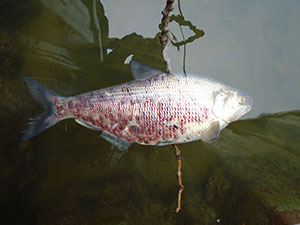 DNR Investigating Citizen Reports of Dead Fish in Lake St. Clair/>The Michigan DNR is investigating several fish mortalities particularly of gizzard shad that have been reported by citizens around Lake St. Clair.
A number of samples have been collected to determine the cause. Some of the fish may have been affected by viral hemorrhagic septicemia virus (VHSv), a very contagious pathogen, but the DNR is still waiting on confirmation.
"Thanks to the publics vigilance we are able to get timely samples from these fish mortalities, and it is very likely VHSv is involved," said Gary Whelan, research program manager for the DNRs Fisheries Division. "VHSv has been detected in these waters since at least 2003, and when conditions are right the pathogen will cause disease events like this one."
Many of the collected fish showed the classic external signs of VHSv: bloody patches on the skin. VHSv first caused fish mortalities in the St. Clair-Detroit River corridor in 2006 and occasionally has been detected in these waters since that time.
- Details
(Provided by MDNR)
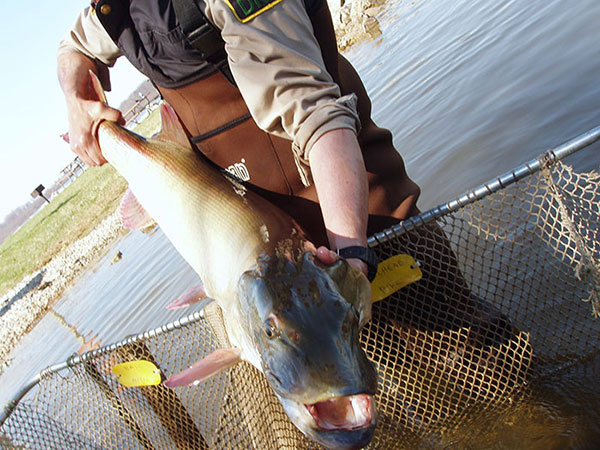 DNR Will Move Muskie This Spring to Build Inland Sources
The Michigan DNR continues to make advancements in the state's Great Lakes muskellunge program, and activities this spring will add to those efforts.
Since 2011, the DNR's Fisheries Division has collected spawning Great Lakes strain muskellunge in the Detroit River. The collected eggs are reared at Wolf Lake State Fish Hatchery in Mattawan and stocked throughout the state in fall. Although the Detroit River is a natural source of this native strain, it presents several challenges.
Water temperatures on the Detroit River typically do not reach optimal levels for spawning until late May or early June, much later than smaller inland waterbodies. This results in a short rearing period and fish not reaching maximum size for stocking each fall. Additionally, the Detroit Rivers expansiveness makes it extremely difficult to efficiently find spawning fish.