

- Details
(Provided by MDNR)
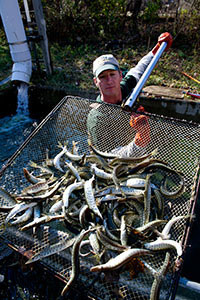 Michigan Muskie Program Creates Opportunities StatewideThe Michigan DNR stocked 25,740 muskellunge fingerlings into 12 waterbodies located throughout the state last year in an effort to further enhance Michigan's world-class fisheries.
Michigan is home to two strains of naturally reproducing muskellunge, Great Lakes and northern. The DNR has been rearing muskellunge in its hatcheries since the 1950s. While the hatchery program initially focused on the northern muskellunge strain, it has shifted focus in recent years to the Great Lakes strain, as it is native to Michigan and widely distributed in waterbodies throughout the Lower Peninsula and eastern region of the Upper Peninsula.
Since 2011, the DNR has collected eggs and milt (sperm) from adult muskellunge in the Lake St. Clair/Detroit River system. The offspring then are reared at Wolf Lake State Fish Hatchery in Mattawan. This hatchery is the only facility in the state currently capable of rearing this species. The muskellunge are reared in hatchery tanks and then transferred to outside ponds after a few months.
- Details
(Provided by the club)
A new Wobble Trap Course at the Berrien County Sportsman's Club in southwest Michigan is available to the public.
The project was in the works for several years, and finally started to come to reality in July under the guidance of Trap and Skeet Chair Tom Holt, who says demand for this type of course in the area was high.
"The most competitive people I've ever met are Trap shooters," said Holt. "Trap shooters are rabid about the sport. I encourage everyone to come out and shoot, whether they are experienced in Trap or not. The point is to come out here and have fun."
- Details
(Provided by MDNR)
A 1.5-year-old buck taken Wednesday, Nov. 16, in Clinton Countyís Eagle Township is likely the ninth free-ranging deer in Michigan to test positive for chronic wasting disease (CWD).
A hunter took the animal within an area where deer check is mandatory and brought the deer to a Department of Natural Resources check station. Preliminary tests conducted by the DNR came back positive for CWD. The animal currently is being tested by the U.S. Department of Agriculture's National Veterinary Services Laboratory in Ames, Iowa, to finalize confirmation of the disease. Confirmation will take a couple weeks.
The DNR reminds hunters that bringing harvested deer to a DNR check station is critical to helping the state understand the extent of CWD in Michigan.
"This latest suspect deer reinforces how critical hunters are in battling this disease," said Chad Fedewa, DNR wildlife biologist. "We are counting on hunters to bring their deer in for testing so we have a better understanding about disease distribution. If this hunter had not followed the law, we would have no idea that the disease has traveled farther west."
- Details
(Provided by MDNR)
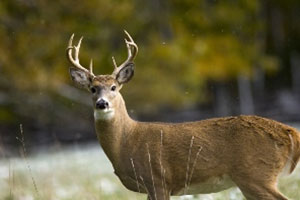 Hunting Continues to Drive Economic Impact in MichiganHunting remains a vibrant annual tradition in Michigan, with generations across the state and beyond preparing for Opening Day on Tuesday, November 15. Along with that rich heritage comes a significant impact on Michigan's economy.
This year, more than 525,000 hunters are expected to participate in the annual firearms season for deer which accounts for the largest economic impact of hunting in the state. The DNR estimates more than 90 percent of Michigan hunters will pursue deer this year, with hunters spending an average of 7 days afield during the firearm season. In Michigan, 60 percent of hunters hunt only deer making the upcoming firearm season especially critical for the economy.
The U.S. Fish and Wildlife Service estimates hunting in Michigan generates more than $2.3 billion in economic impact in the state, including expenses related to food and lodging and $1.3 billion spent on equipment.
"Hunting provides the perfect opportunity to get out and experience Michigan's vast natural resources while contributing to the tremendous quality of life found here in our state," said Michigan Economic Development Corporation CEO Steve Arwood. "We know hunting drives travel to Michigan as well as within the state, and that travel in turn generates economic impact for communities and businesses across Michigan."
In addition to the overall economic impact of hunting provided by the U.S. Fish and Wildlife Service, in 2015 leisure travel spending on hunting reached an estimated $123.8 million, up from $85 million in 2014, according to data from D.K. Shifflet. Hunting and fishing leisure travel spending came in at a combined $340 million in 2015.
- Details
(Provided by MDNR)
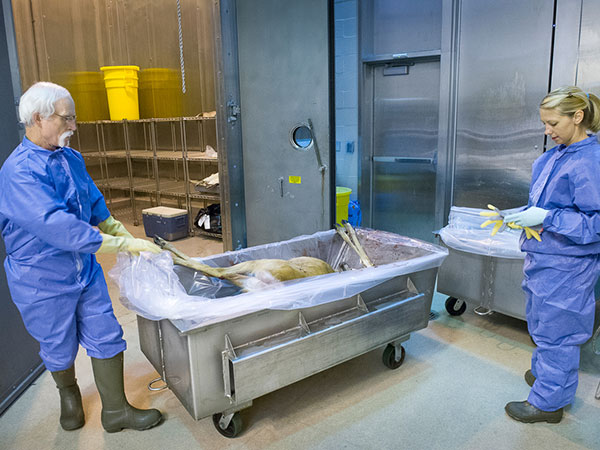 DNR Disease Laboratory workers prep a deer for testing.
DNR Disease Laboratory workers prep a deer for testing.
The discovery of an eighth free-ranging Michigan white-tailed deer with chronic wasting disease this summer was a disappointment to Michigan DNR wildlife officials.
However, DNR deer and elk specialist Chad Stewart said there was a little bit of good news associated with that discovery.
DNA testing showed that the latest infected deer was related to four of the other previously identified infected deer," Stewart said. "So far, all eight have been related to each other somehow, most very closely.
"The overall numbers are still very low, so we're optimistic we can have some success in keeping this disease confined to a relatively small geographic area."
Michigan's first brush with CWD - an always fatal neurological disorder that infects members of the deer family - occurred in 2008 when an infected 3-year-old doe was discovered in a captive deer facility in the southwestern Lower Peninsula.
That facility was depopulated and none of those deer tested positive for the disease.