


- Details
(Provided by MDNR)
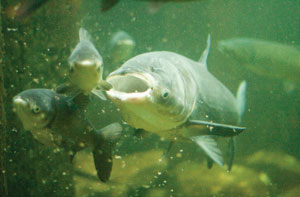 No Bighead or Silver Carp Detected In Michigan's WatersThe Michigan DNR announced that so far in 2016, no bighead and silver carp environmental DNA (eDNA) has been found in Michigan waters.
The eDNA surveillance program ñ a collaborative effort between the Great Lakes states and the U.S. Fish and Wildlife Service (USFWS) - samples high priority locations for the presence of bighead and silver carp genetic material.
Since 2013, the DNR has partnered with the USFWS to implement a portion of the eDNA surveillance program in major tributaries to all the Great Lakes except Lake Superior, because it has been deemed very low-risk for introduction. This year, more than 2,445 samples will be collected, bringing the total from the last three years to approximately 7,200 water samples collected and analyzed. The majority of samples are taken from Lake Michigan tributaries such as the St. Joseph, Kalamazoo, Grand and Muskegon rivers.
Of the 2016 samples collected and analyzed, The DNR is still waiting for results from the third and final round of sampling in the St. Joseph, Grand, Kalamazoo, Muskegon, Macatawa, Galien and Black rivers. The final results are expected soon, but all other samples analyzed have come back negative at this point.
ìAlong with our participation in the eDNA surveillance program, we continue to be diligent with early detection efforts, such as conducting fish population surveys, increasing awareness among anglers, and maintaining an invasive carps reporting website for anglers to share any suspicious catches or observations that occur during their outings,î said Seth Herbst, the Fisheries Divisionís aquatic invasive species coordinator.
During the course of these sampling efforts, a single eDNA sample tested positive for silver carp genetic material in the Kalamazoo River in 2014. Based on further testing and work on the river, it was unlikely that the single detection out of 1,850 samples in 2014 was associated with a live fish.
ìA more likely explanation for that positive sample was a contamination source, such as visiting boaters or anglers from an area where silver carp is already established,î said Nick Popoff, manager of the DNRís Aquatic Species and Regulatory Affairs.
Results from eDNA testing conducted by the USFWS and its partner agencies throughout the Great Lakes basin can be viewed at: https://www.fws.gov/midwest/fisheries/eDNA.html.
For more information on invasive carp, visit Michigan.gov/invasives.
- Details
(Provided by MDNR)
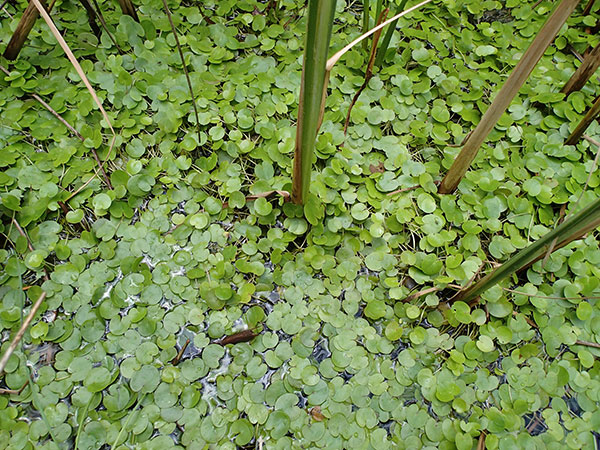 European Frogbit Detected in West Michigan Lakes
The Michigan DNR has confirmed the presence of European frogbit, a prohibited aquatic invasive plant, in Reeds and Fisk lakes in the city of East Grand Rapids.
European frogbit was first verified in Michigan in 1996 along the Great Lakes waterways in southeastern Michigan and has since been found in areas along Lake Huron and the eastern Upper Peninsula. The detections on Reeds and Fisk lakes represent the westernmost known locations of this invasive plant in Michigan and the Midwest. ††
Staff from PLM Lake and Land Management Corporation initially identified the plant during a routine lake inspection and reported the finding through the Midwest Invasive Species Information Network (MISIN), triggering a notification to the DNR and the Department of Environmental Qualityís Aquatic Invasive Response Team. The team currently is assessing the risk level of the situation and working with partners in the community, including the city of East Grand Rapids, Kent Conservation District and the West Michigan Cooperative Invasive Species Management Area, to develop an action plan.
What is European frogbit?
- Details
(Provided by MDNR)
The Michigan DNR Wildlife Disease Lab and the Michigan State University Diagnostic Center for Population and Animal Health today announced they have confirmed that a deer in Berrien County has died from epizootic hemorrhagic disease (EHD), a sometimes-fatal viral disease found in wild ruminants.
Infection does not always result in disease. Signs of illness shown by infected animals are highly variable, and range from none at all to extensive internal bleeding and edema (fluid accumulation). The disease is transmitted by a type of biting fly called a midge.
Illness can come on suddenly and severely, but also can linger for weeks or months in a low-grade state. In severe forms of the disease, deer lose their appetite and fear of humans, grow progressively weaker, salivate excessively and finally become unconscious. Due to a high fever and dehydration, infected deer often seek water to lower their body temperature and to rehydrate, and are found sick or dead along or in bodies of water. There is no evidence that humans can contract the EHD virus.
- Details
The Michigan Department of Natural Resources today released its 2016 Michigan Deer Hunting Prospects report. The full text of the report follows.
2016 MICHIGAN DEER HUNTING PROSPECTS
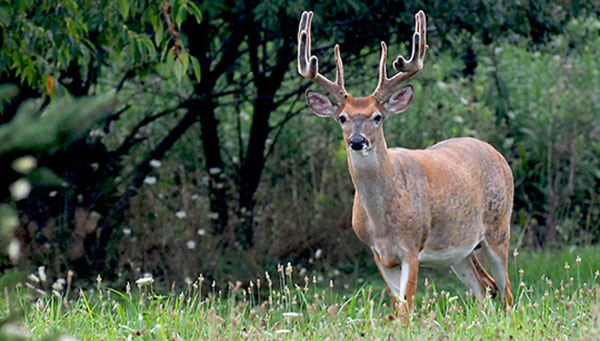 2016 Michigan Deer Hunting Prospects
The leading reason many individuals participate in deer hunting is simply the opportunity to spend time outdoors with friends and family, but harvesting a deer is important to many deer hunters as well. No amount of hunting guarantees a harvest; however, preparation and hard work are keys to producing the best opportunity to see and take deer, or to mentor a new hunter through a safe and enjoyable season. The 2016 deer season is expected to be a successful year for many hunters.
- Details
(Provided by MDNR)
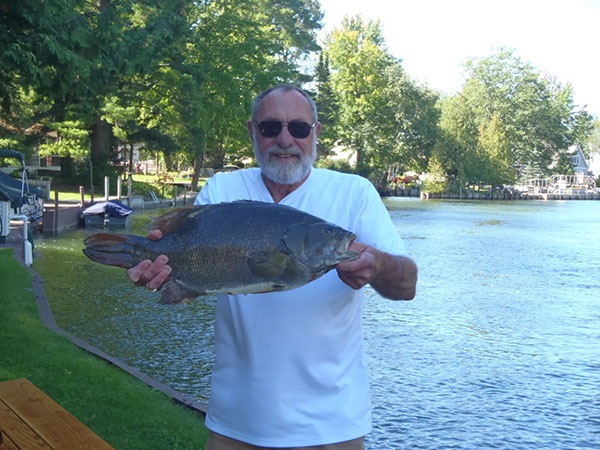 Michigan Smallmouth Bass Record Broken Again!
Michigan's existing state record for smallmouth bass was broken Sunday by Robert Bruce Kraemer of Treasure Island, Florida.
A longtime angler with a cottage in Indian River, Cheboygan County, Kraemer said he's been fishing Michigan waters since 1965, but this is his first state-record catch. Using night crawlers for bait, Kraemer landed a 9.98-pound, 23.10-inch smallmouth bass while out on the Indian River.
"I usually spend June through the end of September up here at the cottage," Kraemer said. "I've got some great fish stories and some nice fish, but nothing like this."
The record was verified by Tim Cwalinski, a Michigan Department of Natural Resources fisheries biologist in Gaylord.
The previous state record for smallmouth bass was set in October 2015 when Greg Gasiciel of Rhodes, Michigan, landed a 9.33-pound, 24.50-inch fish from Hubbard Lake in Alcona County.
Prior to Gasiciel's catch, the smallmouth bass state record had stood since 1906. That fish was a 9.25-pound, 27.25-inch fish from Long Lake in Cheboygan County.
"In just the last four years, anglers have caught a total of 16 state-record fish, a remarkable number of big fish in a relatively short time," said Jim Dexter, chief of the DNR Fisheries Division. "This is just more evidence that Michigan is home to a healthy, robust fishery - a resource and sporting opportunity that continues to draw people from all over."
Kraemer, the new smallmouth bass state record-holder, agreed.
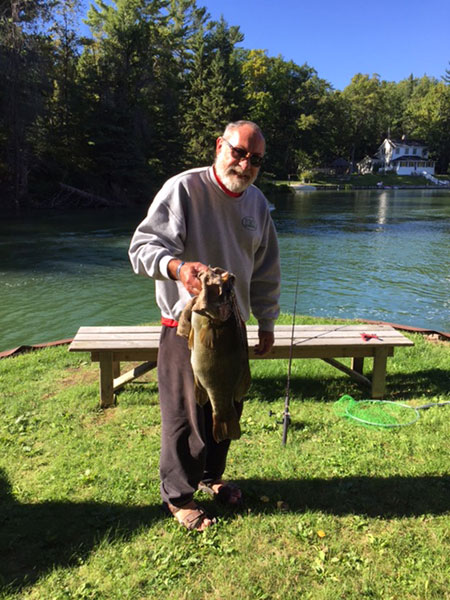 Robert Bruce Kraemer of Treasure Island, Florida"I keep coming back to Michigan for a lot of reasons," he said. "The weather, the clear, cold water, good fishing - it's just nice up here."
Michigan fishing state records are recognized by weight only. To qualify for a state record, fish must exceed the current listed state-record weight and identification must be verified by a DNR fisheries biologist.
For more information on fishing in Michigan, including other state-record catches, visit michigan.gov/fishing.