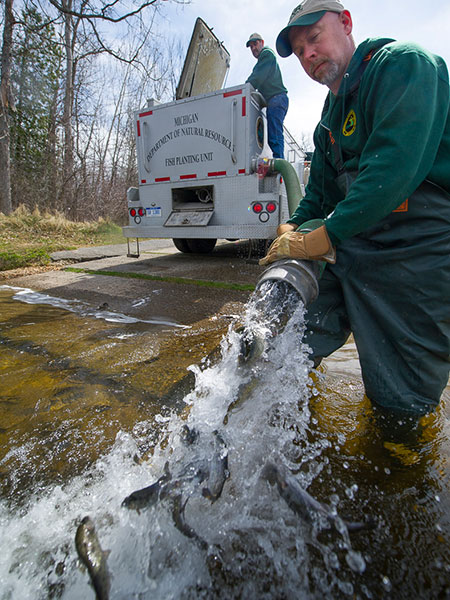


(Provided by MDNR)
DNR Expands Chronic Wasting Disease Core Area and Management Zone
DNR Expands Chronic Wasting Disease Core Area and Management Zone - WDNR Photo
The Michigan Natural Resources Commission expanded the Core Chronic Wasting Disease (CWD) Area to include 17 townships. This area, which will continue to be referred to as Deer Management Unit (DMU) 333, now will consist of Lansing, Meridian, Williamstown, Delhi, Alaiedon and Wheatfield townships in Ingham County; DeWitt, Bath, Watertown, Eagle, Westphalia, Riley, Olive and Victor townships in Clinton County; Woodhull Township in Shiawassee County, and Oneida and Delta townships in Eaton County.
The CWD Management Zone also has expanded; it now will include the remainder of Clinton, Eaton, Ingham and Shiawassee counties, as well as all of Ionia County. The expanded Management Zone will be referred to as DMU 419.
"With the detection of CWD-positive deer in the southern part of Clinton County, we need to better understand the magnitude of the disease in those areas," said Chad Stewart, Department of Natural Resources deer specialist. "Expanding our surveillance to include those areas is key at this point, and we need help from landowners and hunters within the expanded zone to help us with this effort."
(Provided by Michigan DNR)
DNR Ready to Help Evaluate Status of Moose In Michigan
The Michigan DNR will aid the U.S. Fish and Wildlife Service in the federal agency's evaluation of whether the northwestern subspecies of moose ñ found in four states including Michigan ñ should be added to the list of threatened and endangered species affording federal protection.
"We will work closely with the Fish and Wildlife Service and the states of Wisconsin, Minnesota and North Dakota to further this important evaluation," said DNR Wildlife Division Chief Russ Mason. "Moose are one of Michigan's iconic wildlife species."
In an announcement this week, the Fish and Wildlife Service found a petition filed by The Center for Biological Diversity in May. and Honor the Earth "provided substantial scientific or commercial information" that listing under the Endangered Species Act may be warranted.
"This substantial 90-day finding initiates a rigorous status review in which the Service will determine whether the species warrants listing under the Endangered Species Act," the Service said in a news release.
To ensure the process is comprehensive and the final determination is based on the best available scientific and commercial data, the Service has opened a 60-day comment period to solicit relevant information from the public.
Michigan DNR launches online baitshop locator site
The Michigan DNR recently launched a new tool on its website that assists individuals with locating retail bait shops across Michigan. The Retail Bait Shop Locator [ http://www.midnr.com/Publications ] is a comprehensive map featuring licensed bait retailers that sell minnows, wigglers and crayfish to the general public.
The web-based application is ideal for those planning trips across the state who need to purchase bait along the way. It can be found by visiting Michigan.gov/fishing and clicking on Fishing in Michigan, and then Commercial Bait Industry in the left navigation. The Retail Bait Shop Locator is not a downloadable app, but is compatible with all types of electronic devices.
(Provided by MDNR)
Get SMART About Michigan's Urban Coyotes
Many suburban and urban Michigan residents have had an encounter with a coyote. A glance out a window may result in a shock when locking eyes with a large, gray-brown canine standing in the backyard.
A backyard or city park is certainly no place for a coyote, right?
Coyotes can be found everywhere - forests, fields, farmlands, backyards, neighborhoods and cities.
Resourceful members of the dog family, coyotes have used human development to their advantage.
"Coyotes have learned how to survive in urban landscapes, even near people. They take advantage of abundant natural foods that can often be found in urban and suburban areas," said Hannah Schauer, a Michigan DNR wildlife technician. "Because they are highly adaptable, coyotes have expanded their range throughout North America, and can be found in every county in Michigan."
Urban Coyote SMART
The DNR offers a few reminders (in the form of the acronym "SMART") for those who have seen a coyote in their neighborhood.
Curious Coyotes
Coyotes are, by nature, very curious animals and will investigate objects of interest. Something such as a smelly trash bin might grab the attention of coyotes and they may venture close to a building to check it out.
While a coyote's presence in developed areas usually goes unnoticed, occasionally a coyote may get too comfortable being around people and lose some of its natural fear of humans.
As a coyote's curiosity draws it closer to where humans are found, it may start getting comfortable in these places, particularly if there are food sources available and there is nothing threatening about the experience.
"Say, for instance, someone has a bird feeder in their backyard. This free buffet will attract all kinds of critters, not just birds," Schauer said. "Squirrels, raccoons, rabbits and mice are just a few examples of animals that will also visit bird feeders."
Coyotes will be attracted to bird feeders, but not necessarily for the bird seed.
"Coyotes, fox, hawks and other predators will find bird feeders to be an excellent place to catch a meal," Schauer said. "Bird feeders tend to draw small birds and mammals out into the open, making them much easier prey to catch."
Beyond trash cans and bird feeders, there are other manmade attractants that make living close to humans advantageous for coyotes.
Brush or debris piles, shrubbery and other landscaping provide excellent shelter for many animals, including coyotes, and more importantly, prey coyotes like to eat, like mice and rabbits.
Vegetable gardens and fruit trees also provide food sources for smaller animals a coyote will hunt for, as well as for the coyotes themselves. Coyotes are not strict carnivores. They take advantage of seasonally available foods, such as berries, to supplement their diet.
Coyotes may tolerate humans to take advantage of the variety of food sources available to them in inhabited areas.
"In many suburban and urban areas, coyotes have little reason to fear humans," Schauer said. "Humans tend not to realize the coyotes are there, or people do not threaten or try to scare them away. Coyotes are shy, but very intelligent. If they find an area with plenty of food, where humans don't disturb them, they have found an ideal habitat and will stick around."
Coexisting With Coyotes
Fox, Coyote, Wolf Comparison
It is possible for people in suburban and urban areas to coexist with wildlife, including coyotes.
However, many people would prefer not to have them hanging around.
While coyotes weigh in the 25- to 45-pound range, their long legs and fluffy fur coats make them appear much larger and more intimidating.
"As humans, we play a role in reducing potential conflicts with wild animals, including coyotes," Schauer said.
Taking into consideration what we know about coyotes and their need for a safe place where they can find adequate food, shelter and water, we can do a few things to make our space less appealing to them.
Removing food sources such as trash bins, bird feeders and pet food, and fencing off gardens and fruit trees, may make an area less appealing to a coyote because it is harder to find an easy meal.
"Yelling, clapping and chasing off a coyote will let it know that it is not welcome in a person's territory and help it retain its natural fear of humans," Schauer said. "A coyote is not going to want to hang around an area where food is hard to find and people are always threatening it."
For those who have small dogs or cats and are concerned for their safety, the best thing to do is accompany them outside and keep them leashed. A person's presence often will make a coyote wary and discourage the animal from getting close.
Coyotes typically don't bother pets. However, if their natural food sources start to become scarce, a small, unattended house pet could become an easy target. Additionally, coyotes may be aggressive toward dogs they perceive as a threat or an intruder in their territory.
Sightings
In Michigan, people are most likely to see and hear coyotes during their breeding period, which typically occurs January through March.
If there is a den nearby, people also may see the adults throughout the summer as they care for their pups.
As fall approaches, pups begin dispersing from the den site to establish home ranges of their own. These young animals on the move are sometimes more visible.
"In urban areas, a coyote's home range could be as small as 2 to 5 square miles. In more rural areas, a coyote's home range may average 8 to 12 square miles," said Adam Bump, furbearer specialist for the DNR. "The size of the home range is greatly influenced by the food available as well as the number of other coyotes in an area."
Coyotes are active day and night. However, peaks in activity occur at sunrise and sunset. Seeing a coyote during the day does not necessarily mean it is sick.
Removal Options
There are various options available to landowners or residents who may be experiencing problems with coyotes.
In suburban or urban areas a common complaint is that a coyote has grown too comfortable around people and is no longer easily scared away.
When removal of food and attempts at scaring a coyote from an area have not made the coyote more wary of humans, a person may wish to hire a specially permitted nuisance control company to assist in the safe removal of problem animals in urban or residential areas.
"In more rural areas, complaints may include damage to private property," Bump said. "For landowners in an area where hunting or trapping activities are allowed, coyotes may be taken all year on private property by a property owner or designee, when they are doing or about to do damage to private property. A license or written permit is not needed."
Coyote hunting and trapping seasons are available statewide.
"In fact, coyote hunting is open year-round and Michigan residents only need their valid base license to hunt for them," Bump said. "These liberal coyote harvest regulations give tools to landowners and hunters to address local issues they may have."
(Provided by Michigan DNR)
The Natural Resources Commission recently approved new baitfish regulations that affect personally caught bait in Michigan waters. Any personally caught bait now must be used within the same body of water, or connecting bodies of water, where it was captured.
What that means for anglers is that bait can be caught within a tributary of a lake and used within the lake that is connected to the tributary. This principle also applies to chains of lakes that are void of barriers. However, if a man-made dam exists on a tributary that prevents free movement of baitfish between the lake and other connected waters, baitfish may not be moved or used within those non-connected waters.