


- Details
By Louie Stout
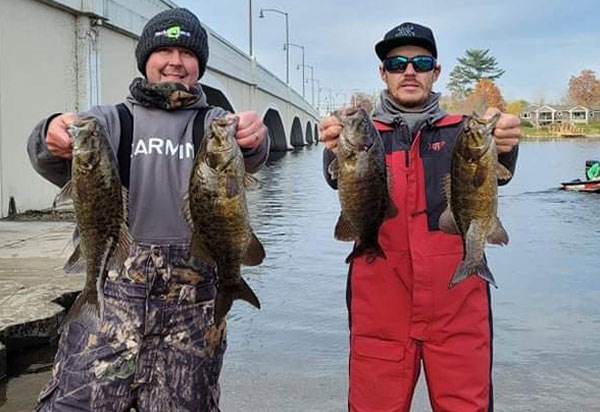 Biologists study St. Joseph River Bass
Has the slot limit offered any change to the bass fishery on the St. Joseph River?
Not much, says Indiana DNR Fisheries Biologist Matt Horsley, who did electro-fishing on portions of the river throughout Indiana last October.
“Our preliminary review indicates not much has changed since we put the new regulation in place,” Horsley said.
But don’t expect any changes or reversal to the old regulation. More about that later.
In 2013, Indiana changed the 14-inch size limit to a slot regulation in which no fish 12 to 15 inches and no more than two fish over 15 inches could be kept. Fish under 12 could be kept providing anglers adhered to the five-fish bag limit.
Biologists hoped that such a change would produce more and bigger bass.
Last October’s survey was a follow-up to a similar study the DNR conducted in 2018. This year, crews electro-fished for 12 hours at various sites from Bristol, Ind. down to St. Patrick’s Park.
“We were looking for any change in the size and structure of the bass population since our last survey,” Horsley said.
Keep in mind that biologists don’t shock all 16 miles of Indiana’s St. Joseph River but they do visit the same areas throughout the river to compare bass populations in each area from one survey to another.
Electro-shocking involves electrodes running below the waterline in the water ahead of a boat, stunning fish that staffers net, measure and release. The electrodes are effective down to about 6 feet.
- Details
By Louie Stout
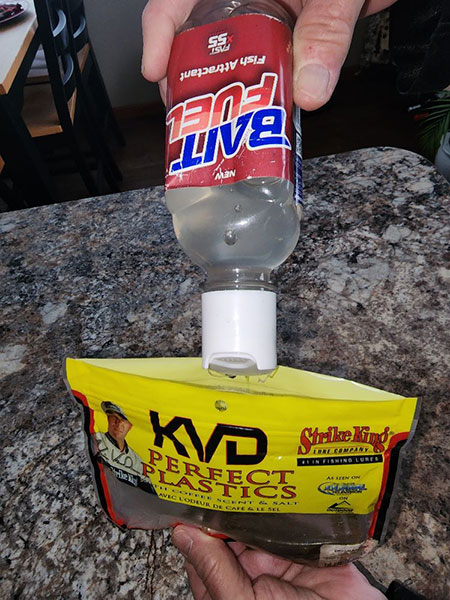 Bait Fuel
Perhaps I’m showing my age, but I remember when Fish Formula became the first liquid fish attractant designed to entice more bites.
A few years later, Berkley introduced PowerBait and Gulp! with attractants built into the soft plastics.
Fish Formula has since disappeared while the Berkley products have remained popular and rightly so.
BaitFuel, produced by American Baitworks, has proven to be a worthy competitor. It’s not only a liquid formula to be applied to any lure, but the company also infuses it in some of its own soft plastic baits, similar to what Berkley has done with PowerBait and MaxScent.
Count me among the new believers, which include several Bassmaster pros.
- Details
By Louie Stout
Anglers who aren’t deer hunting are finding some decent fishing opportunities throughout Michiana.
Diehard panfish anglers are catching a fair share of panfish out deep near bottom and some bass anglers report nice catches on bladed jigs, A-rigs and jerkbaits.
Many of the inland lakes are turning over which can scatter the fish. Turnover occurs when cooler bottom water mixes with surface water and water temperatures remain nearly the same from top to bottom.
Although the fall trout and salmon run into the tributaries is winding down, some winter-run steelhead are making their way into the St. Joseph River and other streams.
“There are definitely steelhead in the streams; a lot of guys are fishing for them in Indiana and Michigan,” said Darrin Schaap of Clear H2o Tackle in Edwardsburg.
In addition, Lake Michigan anglers are catching quite a few lakers from shore and by boat in harbor areas and near the shorelines of northwest Indiana. Most are being caught by jigging or trolling, according to Indiana Lake Michigan Biologist Ben Dickinson.
- Details
By Louie Stout
In early August, a fish kill on Clear Lake got anglers riled up and many were quick to blame weed treatments.
Overzealous chemical treatments can – and have – led to fish die-offs.
But that wasn’t the case at Clear Lake this summer, says Indiana DNR Fisheries Biologist Matt Horsley, who investigated the die-off of about 500 fish.
Horsley said 95 percent of the dead fish he saw were rock bass while a few crappie, bullhead and a couple of bass accounted for the remaining carcasses.
“There was a sizable weed treatment in early June and 1/10th of an acre was treated in the Marina Basin July 26,” Horsley said. “When we see fish kill that are directly caused by chemical applications it will have an immediate impact on the fish.”
Instead, Horsley believes the kill was caused by depleted oxygen overnight in a large weedy flat nearby. Rock bass like to lounge and feed in shallow vegetation after dark.
During hot periods of the summer, as was the case that time, large flats with vegetation consume oxygen at night rather than produce it as they do during the day. As oxygen depletes, fish that utilize that area get trapped and can die.
“Sediment turnover adds to the issue,” Horsley said. “When you have a lot of boating activity during the day like that lake does, boats driving over those shallow flats lifts organic matter into the water column and that depletes oxygen as well. Not only are the plants using the oxygen but decomposition of all that organic matter uses oxygen as well.”